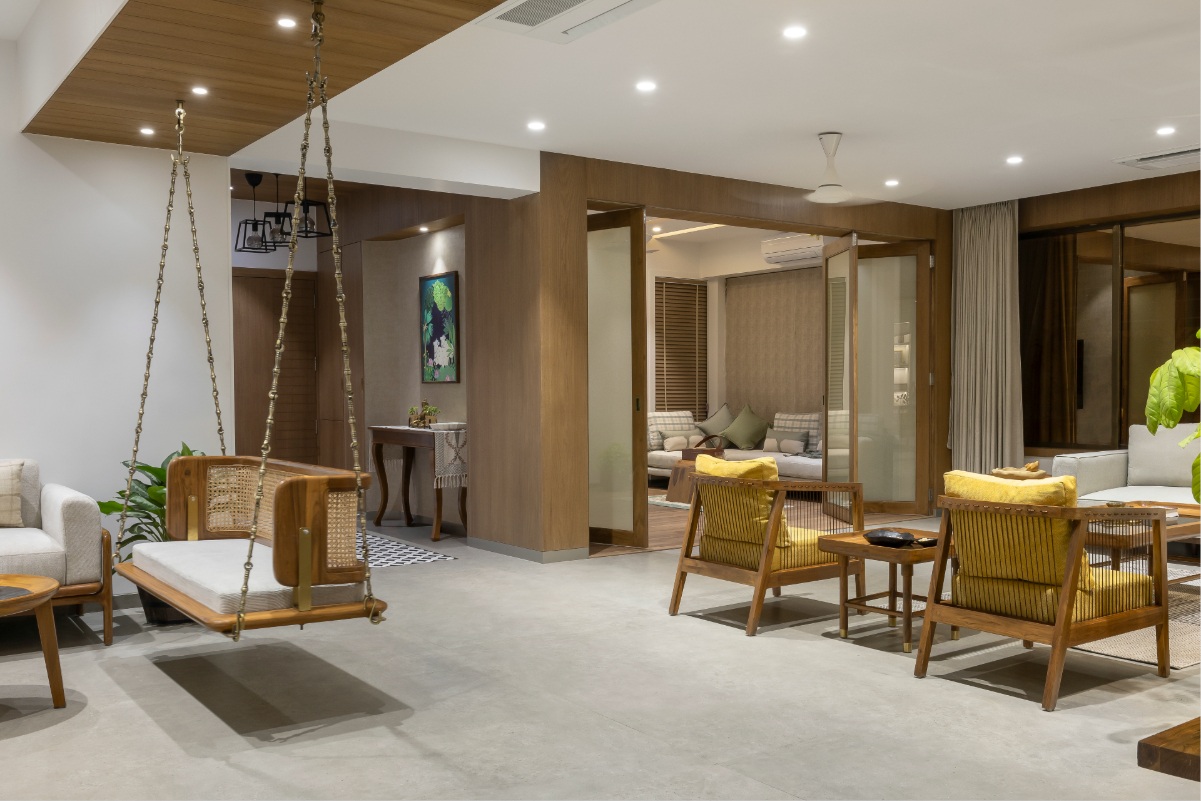
Apartment Interior — Surat, Gujarat
A home that refused
to be a hotel.
On the 9th floor, roots matter more than views.
Apartment Interior — Surat, Gujarat
On the 9th floor, roots matter more than views.
Location
Sapphire Court, VIP Road, Surat
Typology
Apartment · 9th Floor
Carpet Area
4,500 sq ft
Programme
5 BHK · Mandir Room · Family Room
Status
Completed
Year
2024
The Brief
The family had a precise complaint about contemporary interiors in Surat: they all looked like hotels. Clean, sleek, minimal — and completely without soul. What they wanted instead was a home that felt grounded. Modern, yes, but rooted in the textures, objects, and rituals of an Indian household.
This was the opposite of our usual brief. Clients typically ask us to edit things out. This family was asking us to put things back in — warmth, materiality, presence. The challenge was to honour that without giving up what we will not give up on any project: openness, simplicity, and a plan that works.
The First Move
The apartment came with Italian marble. The first thing we did was take it out. In its place: a concrete-textured tile — cool in temperature, matte in finish, industrial in feeling. A floor that does not perform luxury, but receives the rest of the home without competing with it.
That single substitution changed every decision that followed. With the floor quiet and honest, the walls could carry earth tones. The furniture could be solid timber. The objects could be handmade. The home could begin to feel like it had always been there.
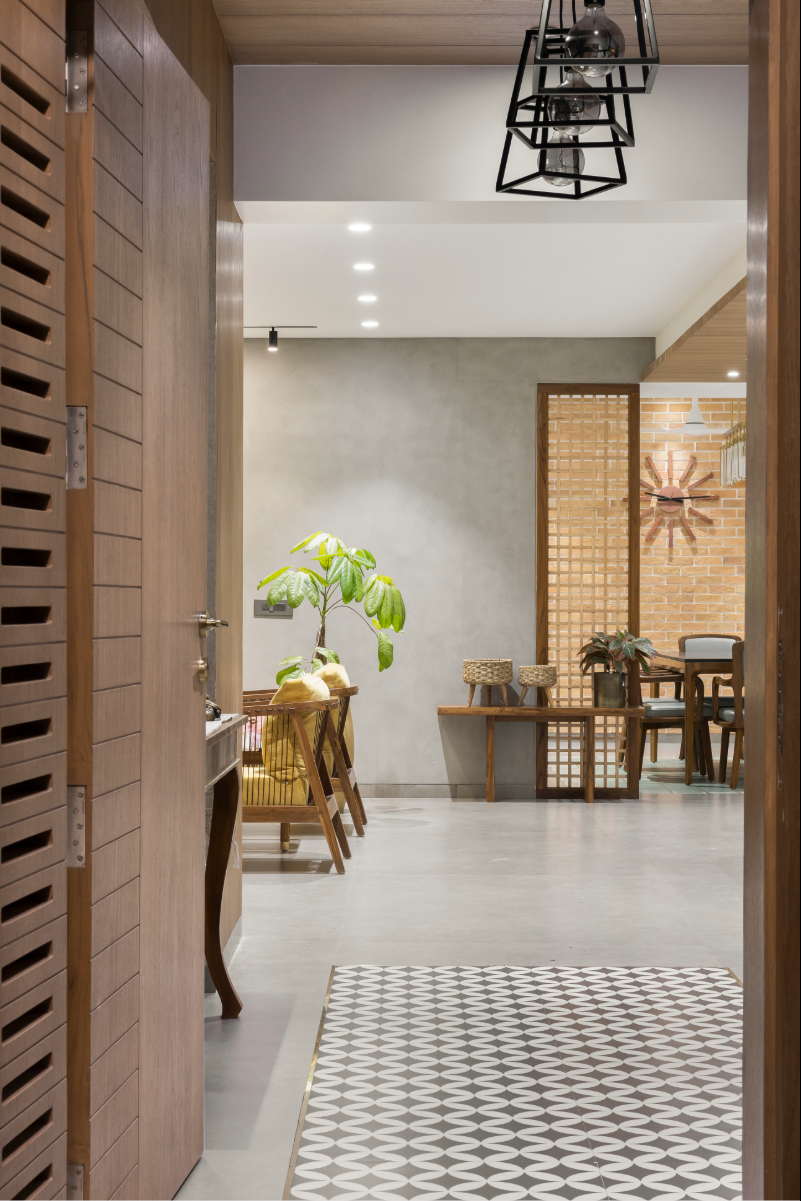
The entry — a patterned cement tile marks the threshold. The timber wall and botanical painting announce the palette before the living room opens.
Arrival
The foyer is small and unambiguous. Timber-clad walls frame the entrance door. A console table — antique-legged, hand-runner laid — holds a Buddha figure and two small plants. Above it, a botanical painting in a deep teal ground. To the right, a pendant cluster of black cage lights.
Nothing here is neutral. Every object has been chosen, and every object is Indian in origin or in spirit. By the time a visitor steps inside, the home has already told them what kind of place this is.
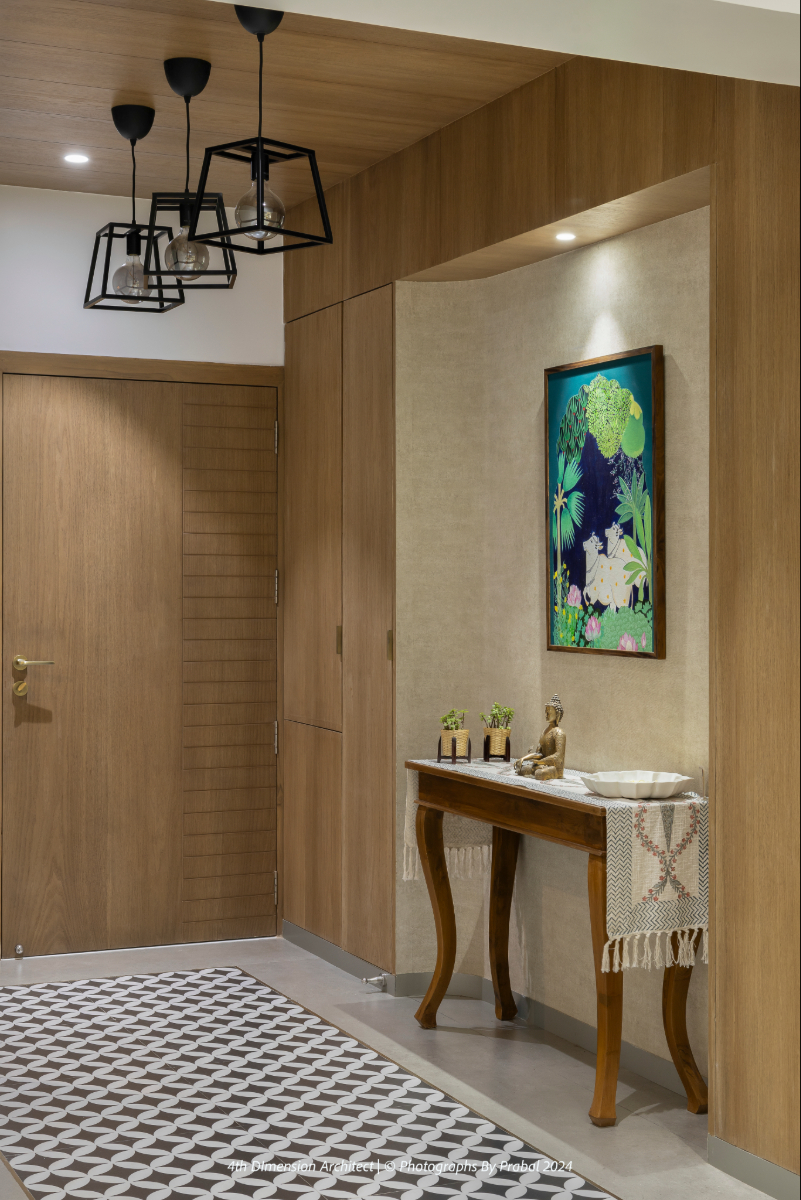
The entry console — the first object in the home, and its clearest signal.
The Living Room
The living room is anchored by two grey sofas facing each other across a teak-framed coffee table. Yellow-cushioned cane armchairs punctuate the seating — colour held to one note, warm against the concrete floor. Above the main sofa wall, two large framed paintings: the only strong horizontal element in an otherwise vertical composition.
To the right, a timber lattice screen — open, not solid — separates the dining room without closing it off. Through its grid you can see the brick wall beyond. The room breathes in both directions: toward the garden-facing windows on one side, and toward the dining and kitchen on the other.
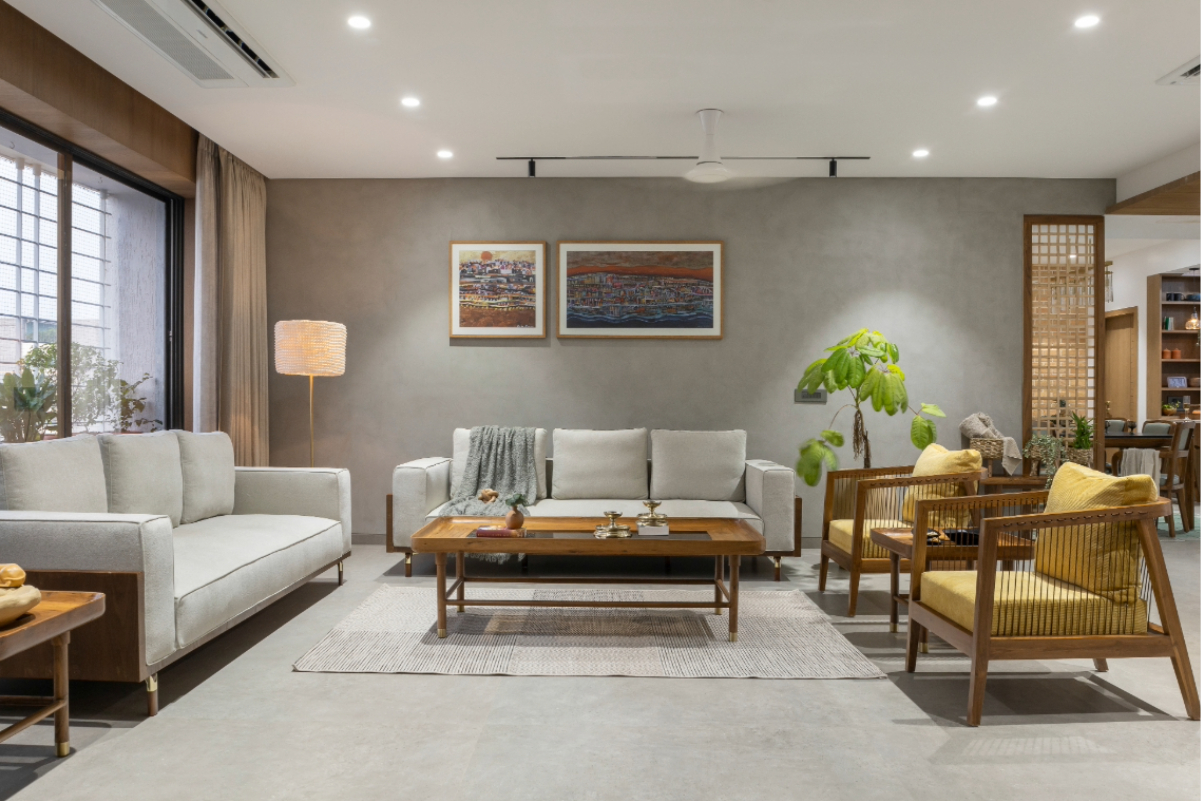
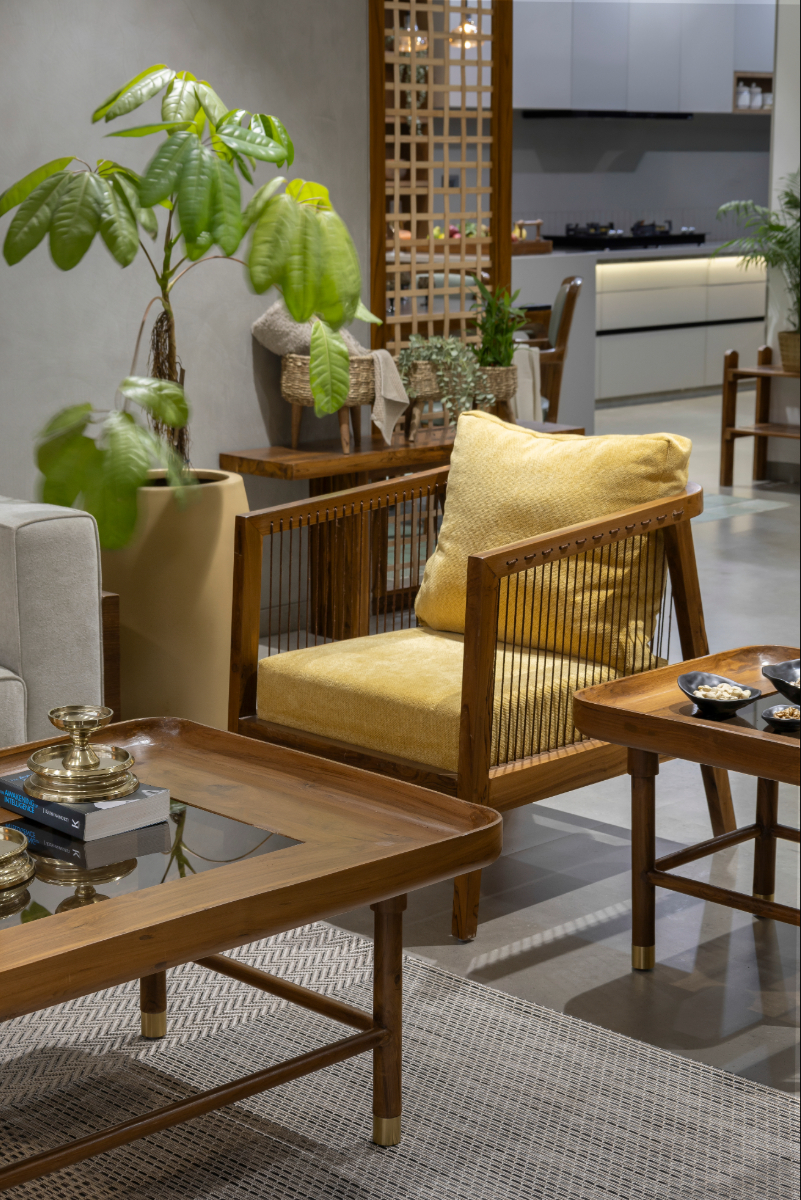
Left: the living room — restrained palette, two paintings, the lattice screen marking the dining edge. Right: the yellow chair — the room's single warm accent, teak and brass at its feet.
The Dining Room
The dining sits between the living room and the kitchen. A grid of eight framed paintings hangs against a green-tiled feature wall. A brass pendant drops over the table — geometric, articulated, a single luxurious gesture in a room of restraint. At the far end, an exposed brick wall holds a sunburst wall clock, anchoring the open end of the floor plate.
Through the lattice screen from the living room, the dining reads as a parallel composition — its own room, but visually continuous. The plan folds back on itself; every room is in conversation with the next.
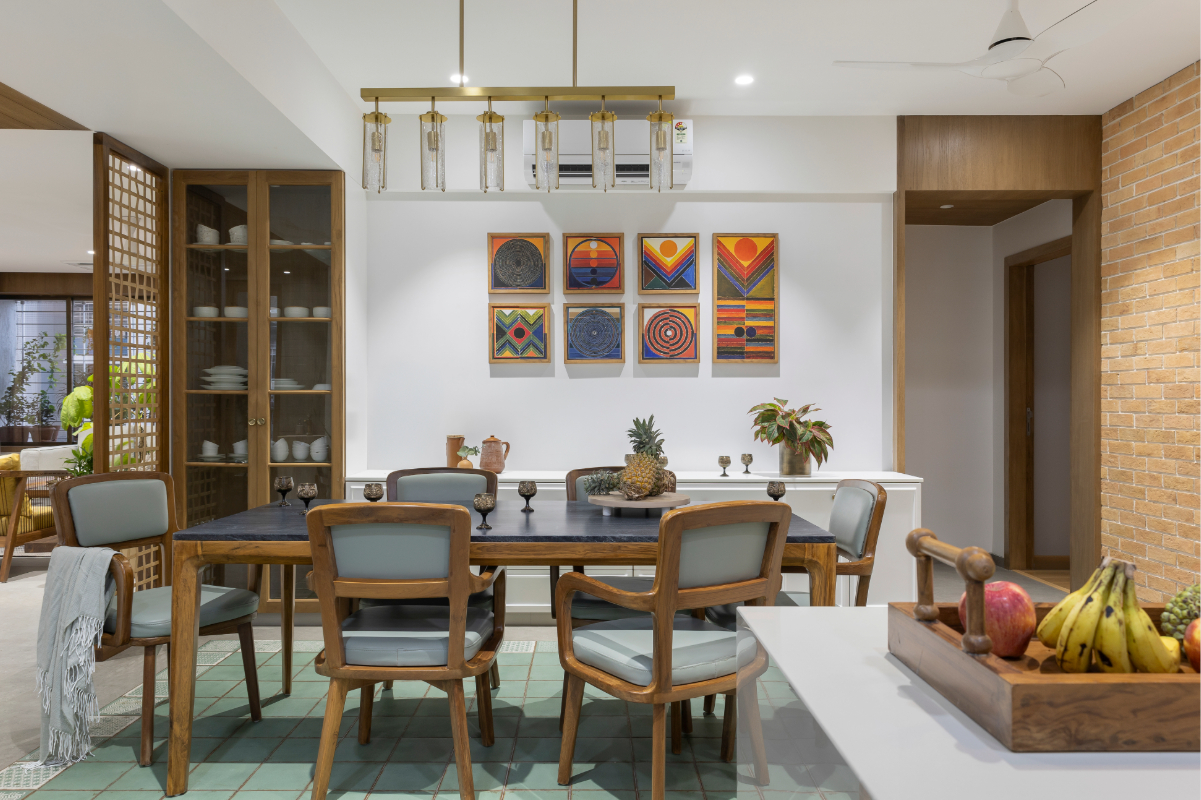
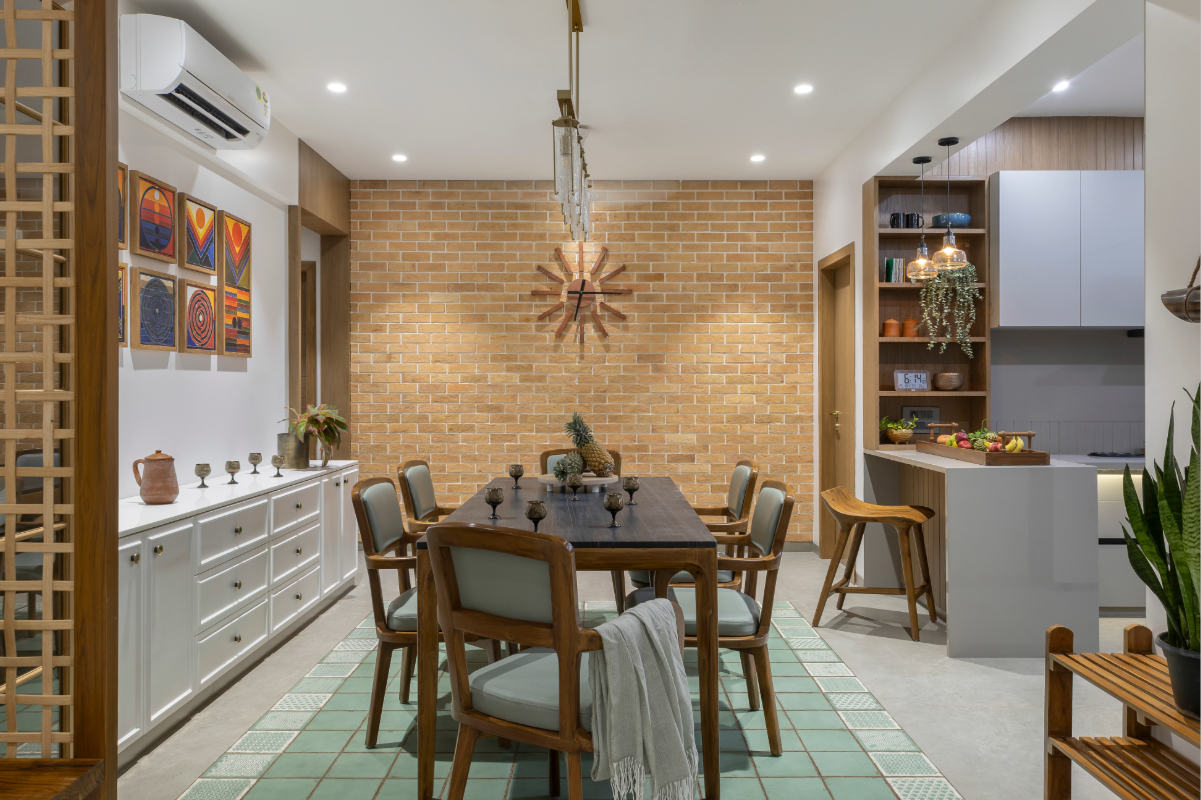
Left: eight paintings, brass pendant, green tile — the room reads as a composition. Right: the brick wall anchors the open end of the dining zone, with the kitchen beyond.
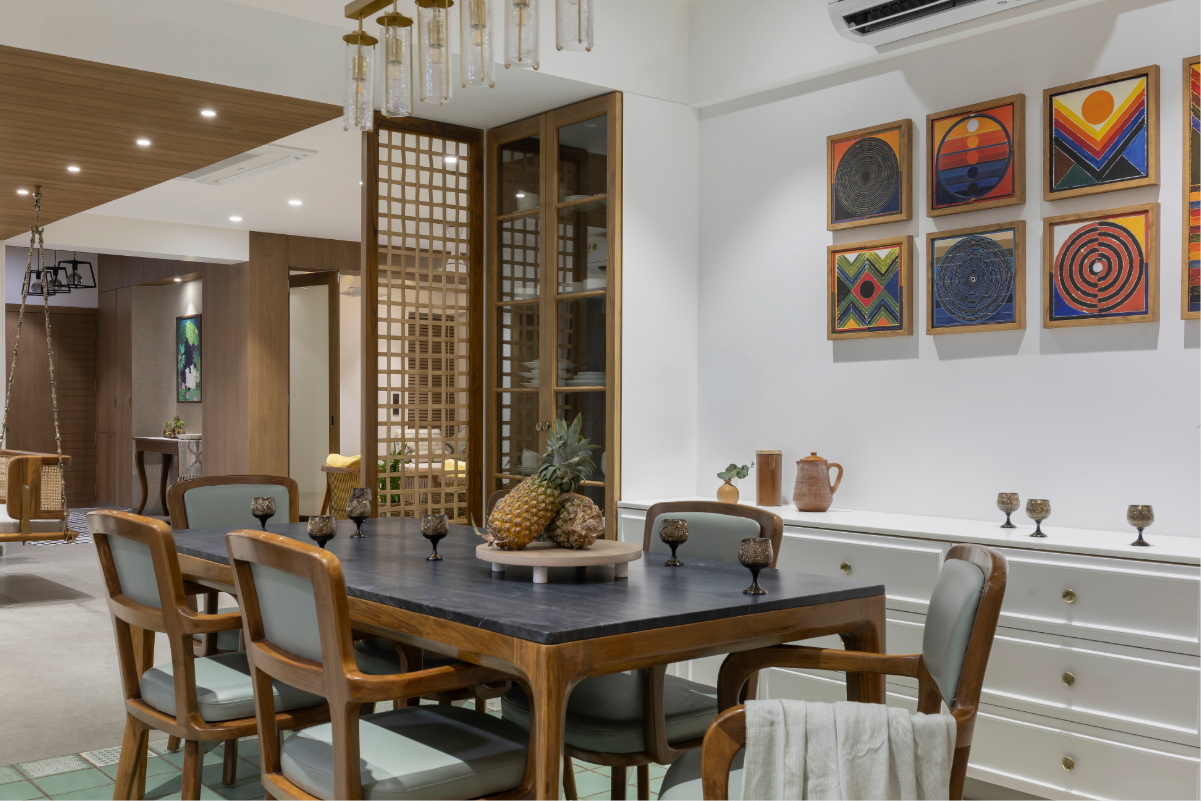
The dining room seen through the lattice — living room and jhula in the background. The plan folds back on itself; every room is in conversation with the next.
The Bedrooms
The brief asked for each bedroom to be designed for its resident, not for a uniform design language. The shared vocabulary — concrete floor, timber, a single colour family — is the thread. Everything else is personal.
The master bedroom was reconfigured by removing an existing toilet, giving the couple the largest room in the home. The floor is raised in timber around the bed — a platform that separates the sleeping area from the rest without a wall. The headboard wall is raw grey plaster, with two leaf forms drawn lightly into the surface. Two brass pendants flank the bed. Mint-green armchairs face the window. Nothing is loud; nothing is hotel.
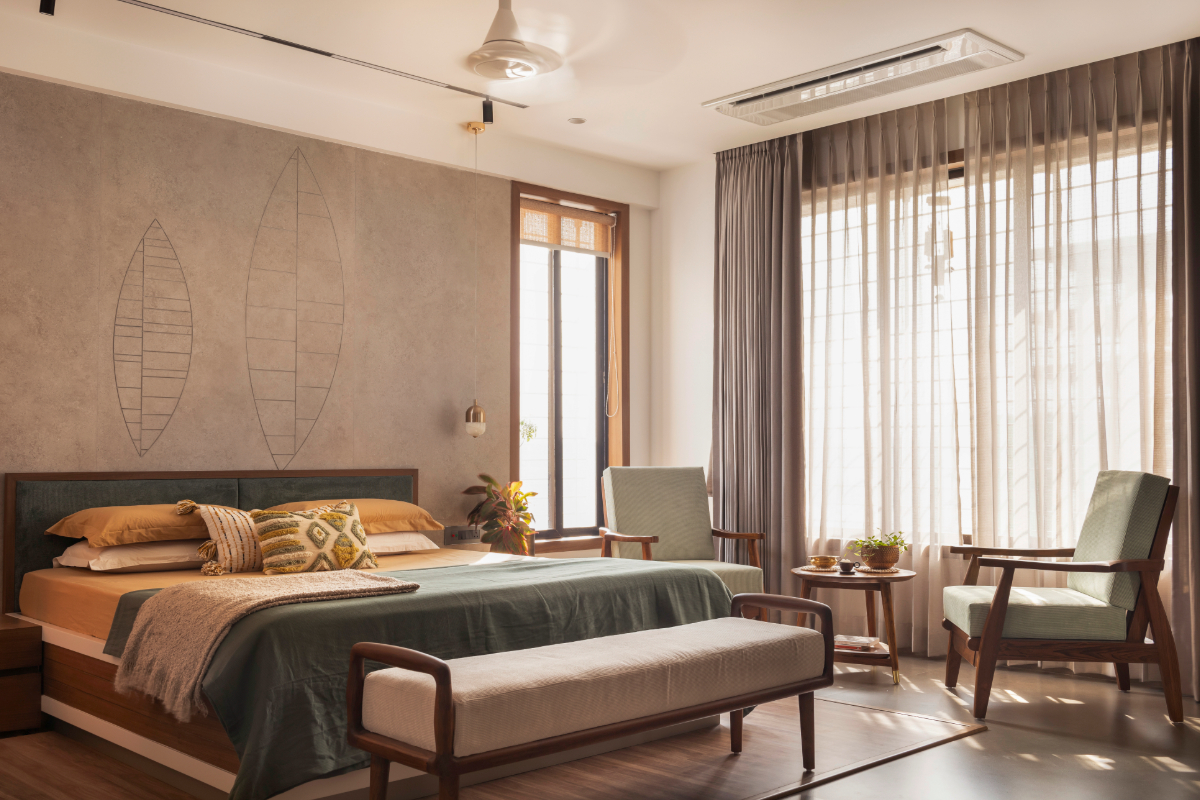
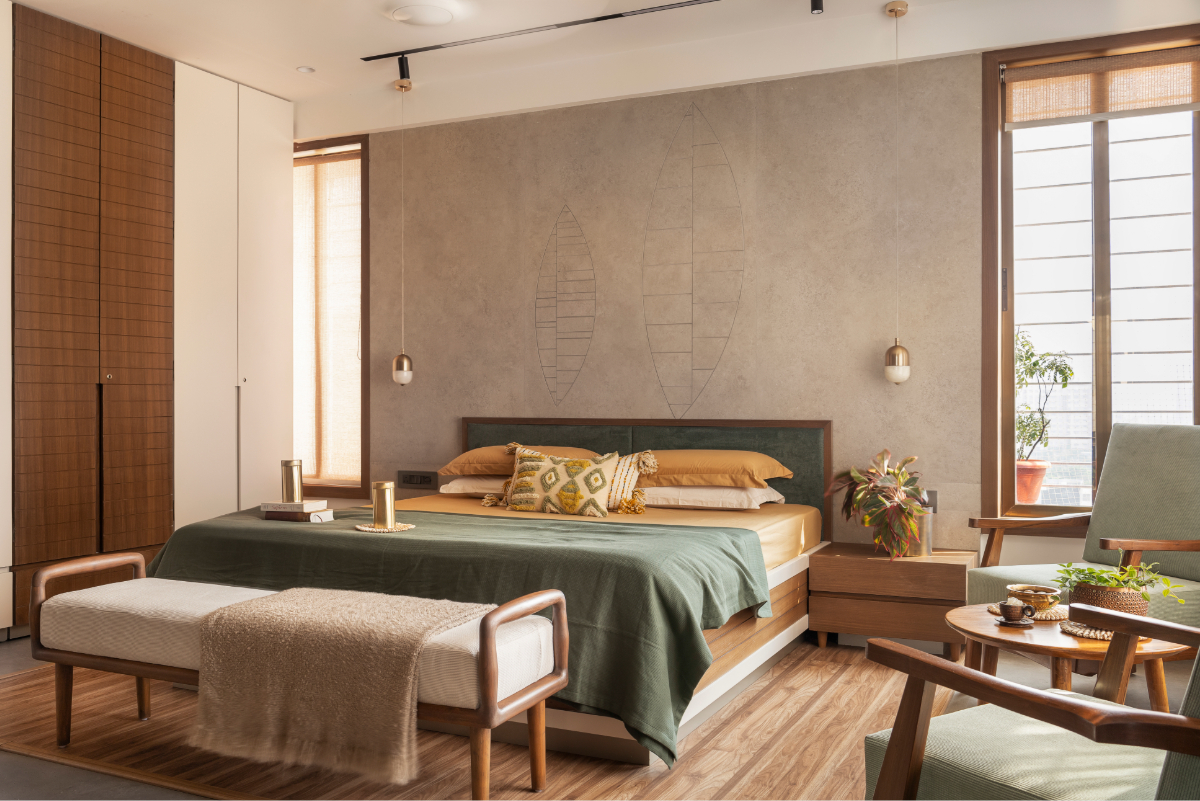
The master bedroom — a timber platform defines the sleeping area without walls. The leaf motifs are drawn, not applied.
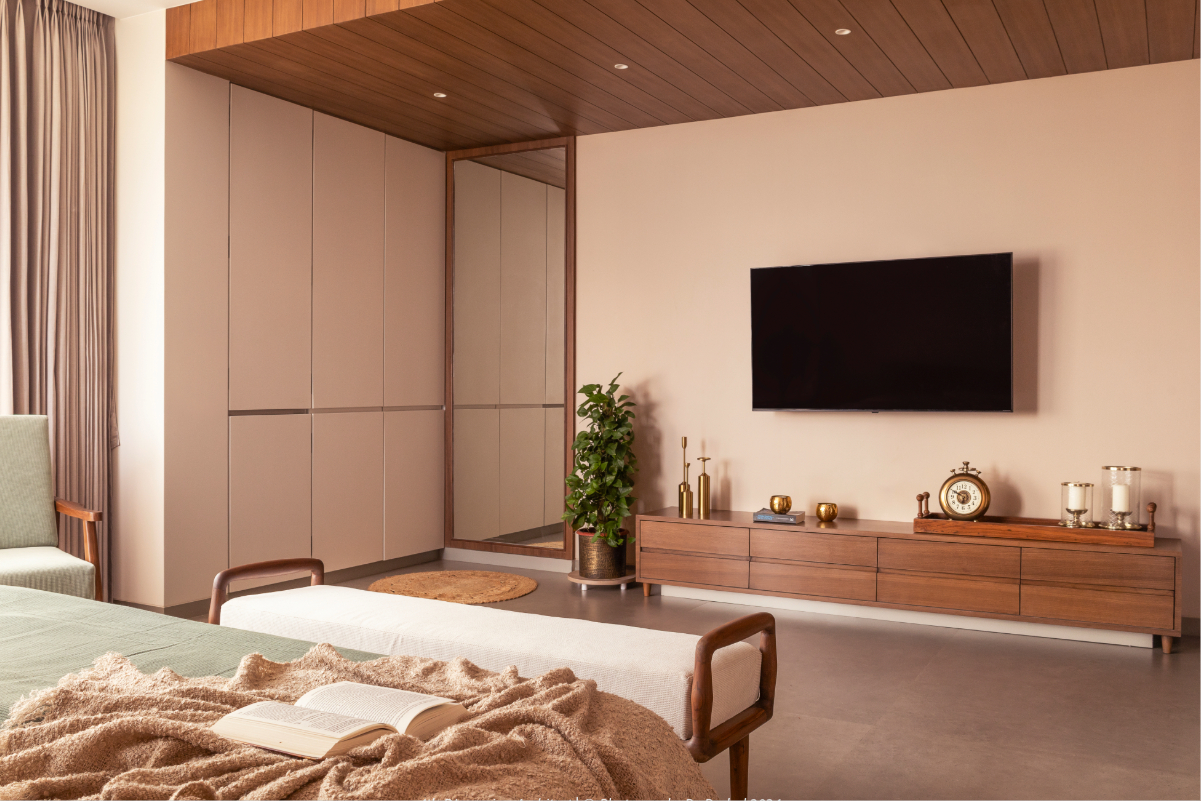
The TV wall — taupe cabinetry, a full-length mirror, and a low teak unit. The room's second palette, quieter than the sleeping end.
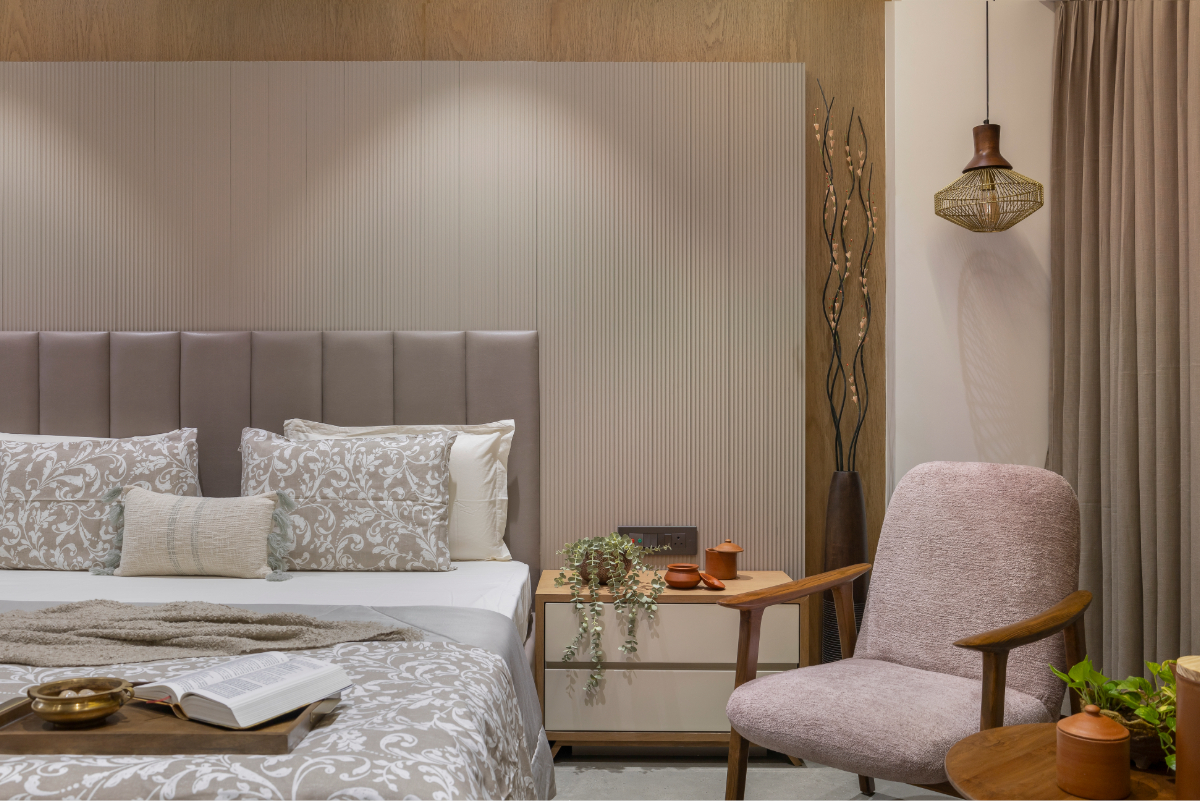
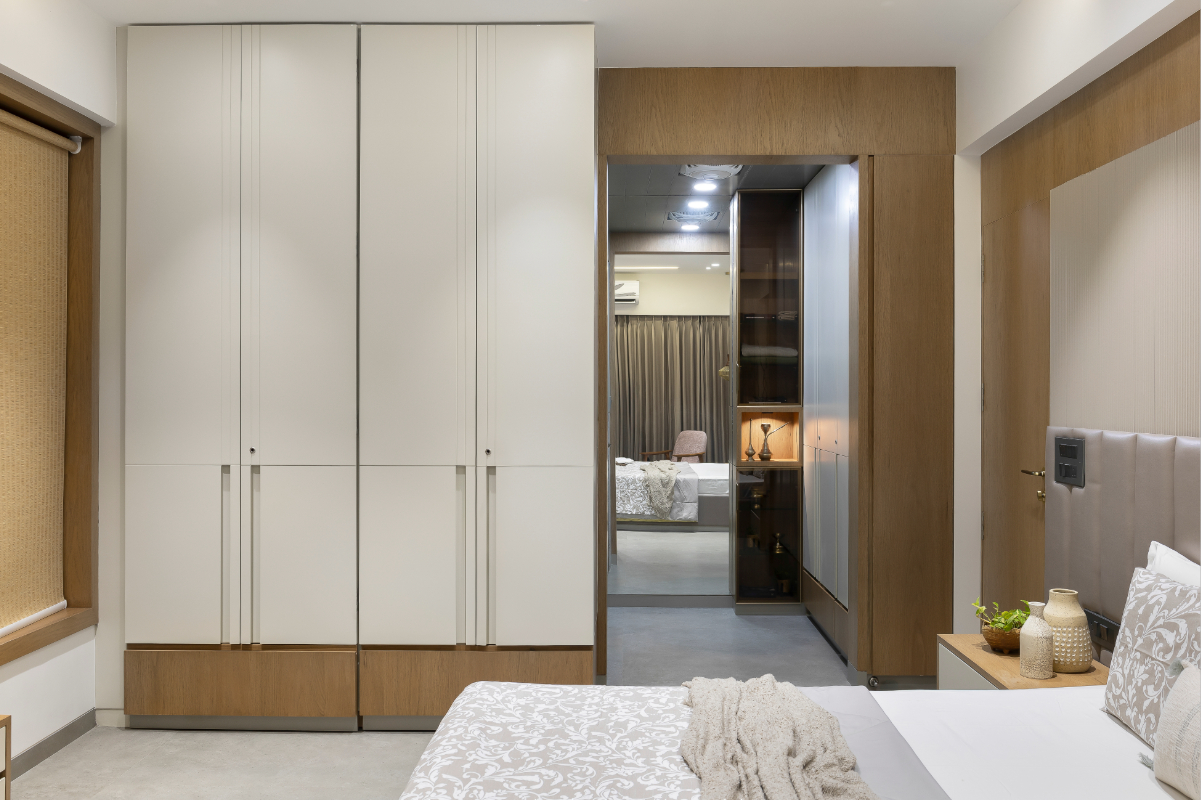
The parents' bedroom — fluted grey panels, a softer palette. The wardrobe door frames a view into the room beyond.
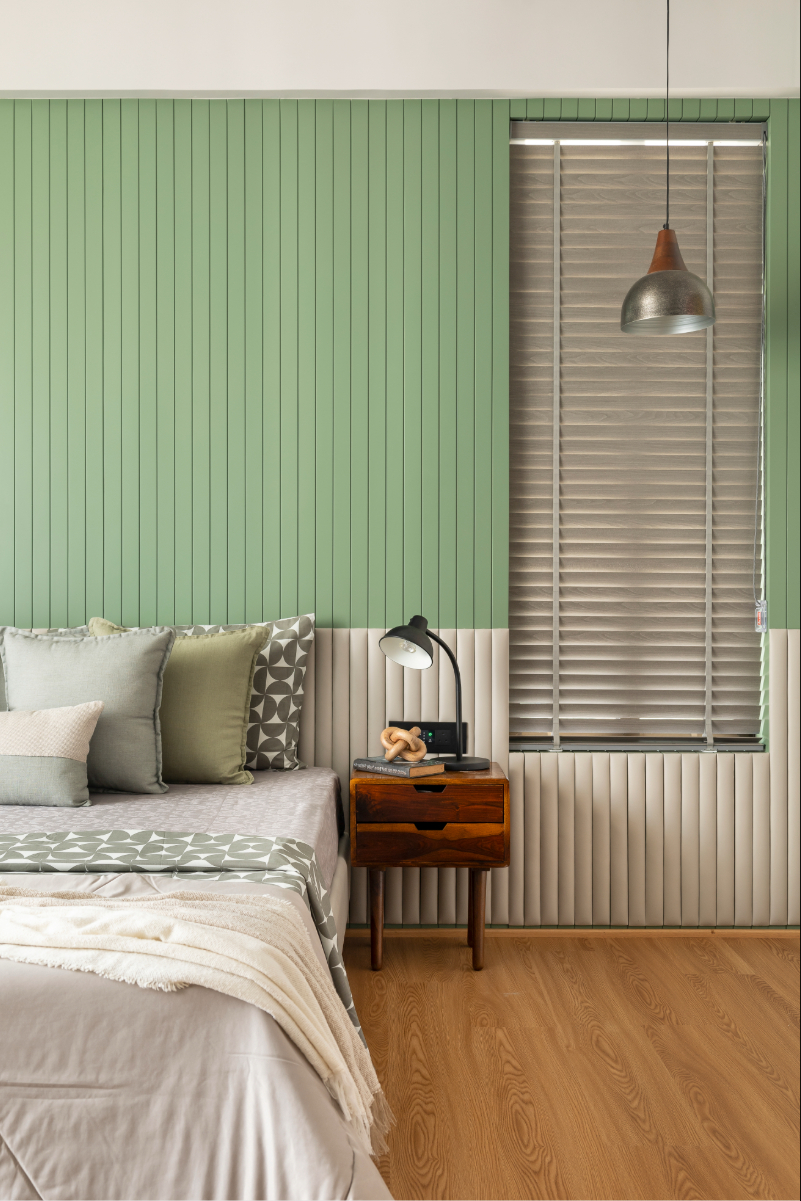
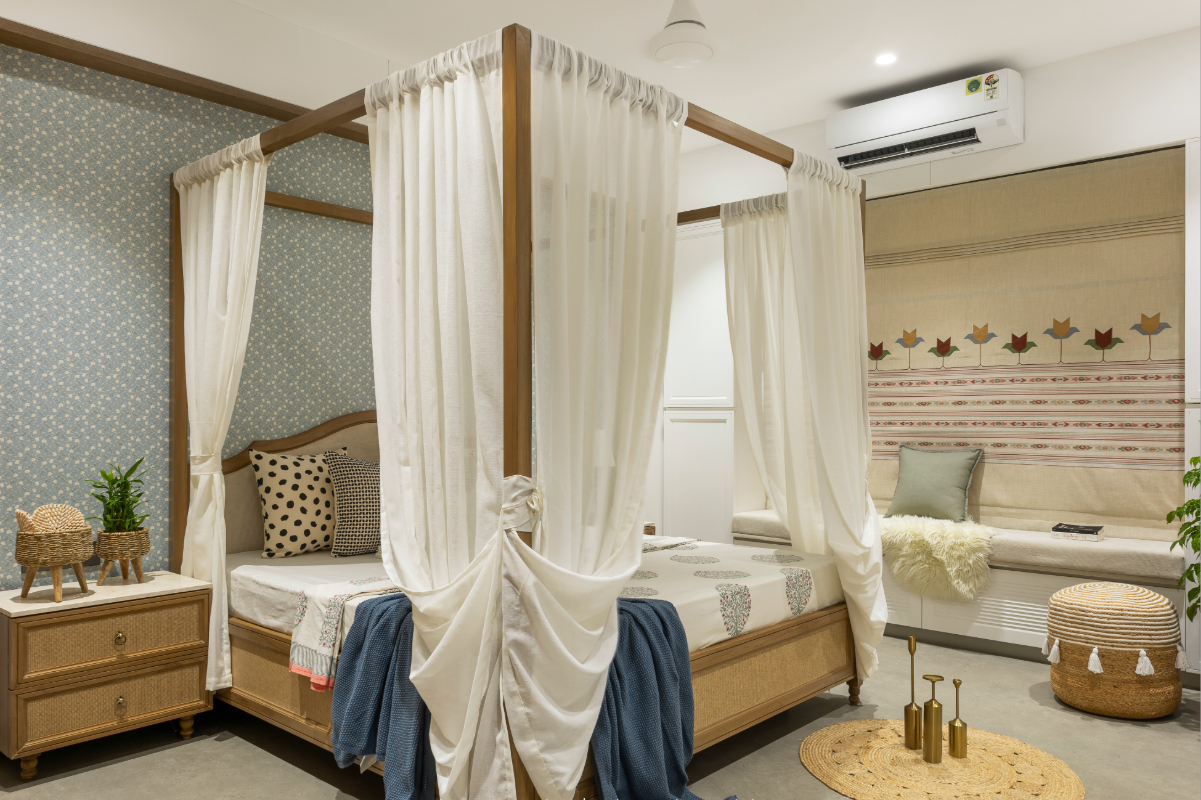
Left: the son's room — sage green, a keyboard, four pop-art prints. The room is his, not the architect's. Right: the daughter's room — a four-poster bed with white drapes, floral wallpaper, a folk-motif panel above the day bed.
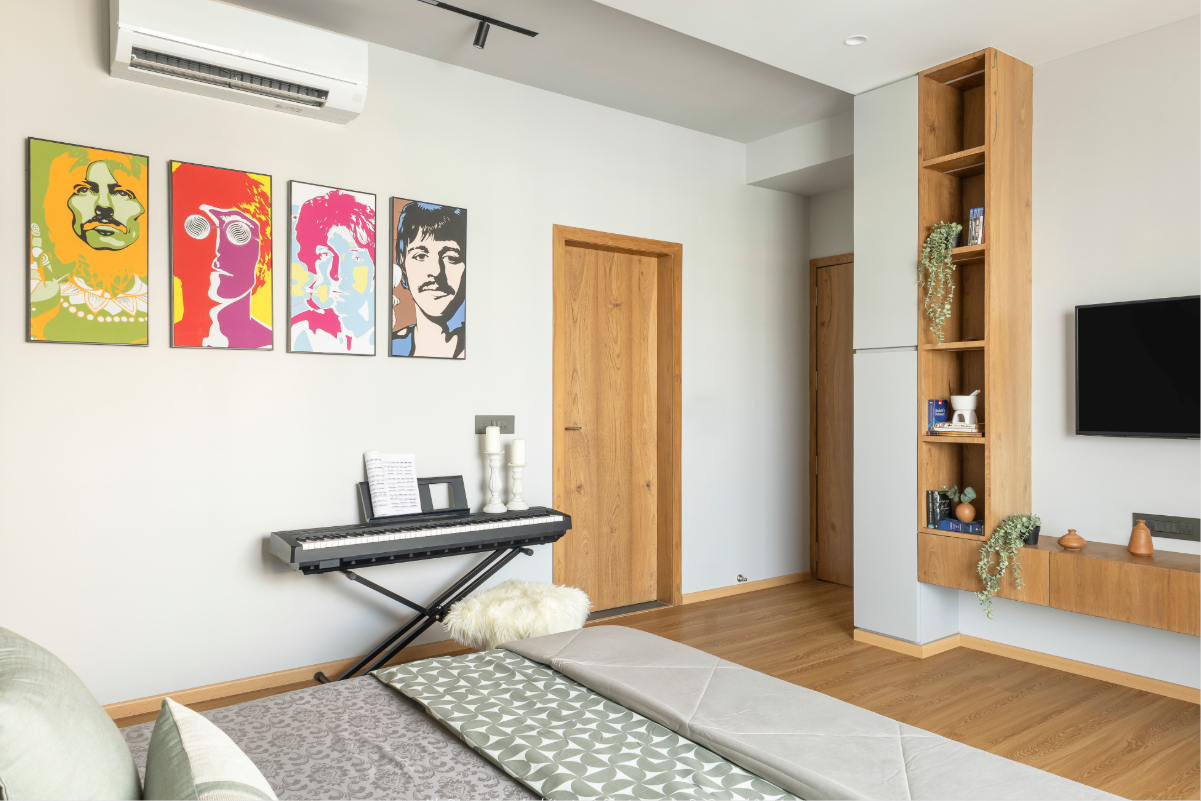
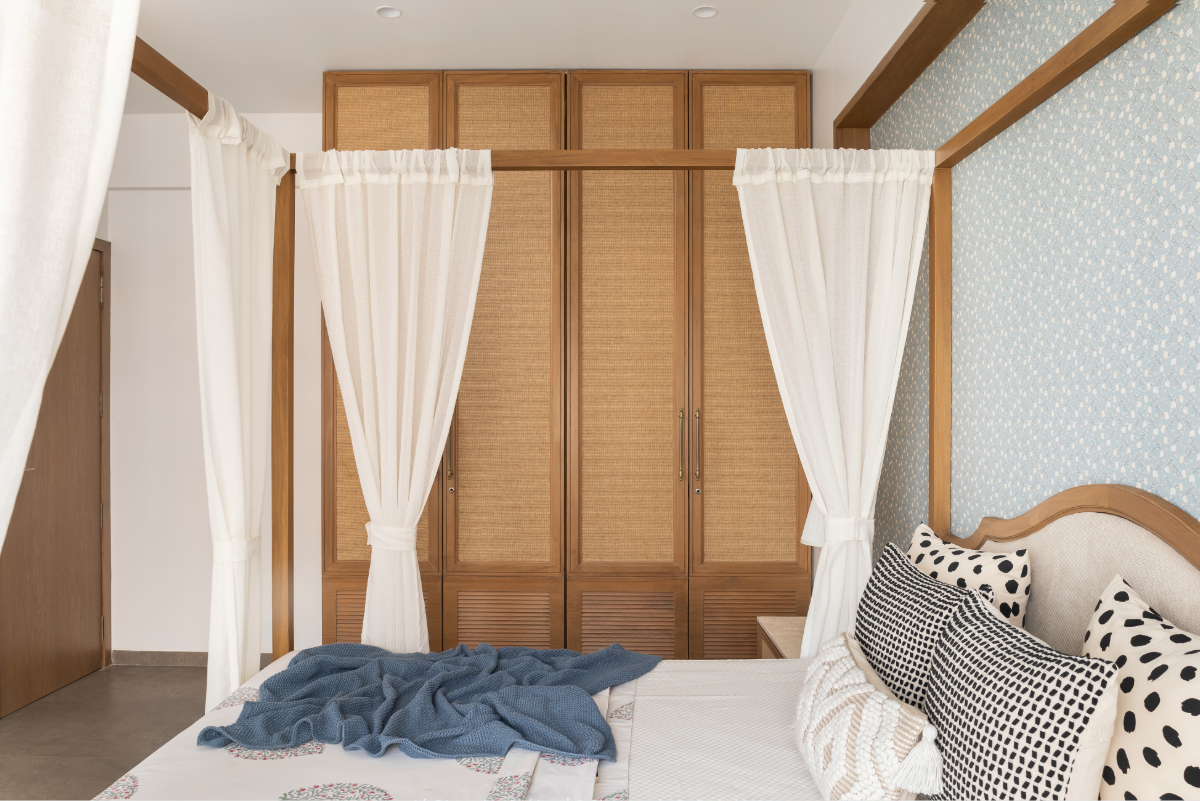
Left: the son's wardrobe wall — natural oak, open shelving. Right: the daughter's wardrobe — rattan panels, brass pulls, consistent with the room's unhurried warmth.
The Balcony
Nine floors up, there is no garden. What the family has instead is a balcony treated as a garden room: dark green textured plaster on all three walls, a teak bench, and potted plants arranged around it. Folk art medallions hang against the plaster — circular, hand-painted, each one from a different craft tradition.
This is where the family comes when the apartment feels like an apartment. The wall behind the bench does not feel urban. It does not feel like the 9th floor of a housing society. That is the point.
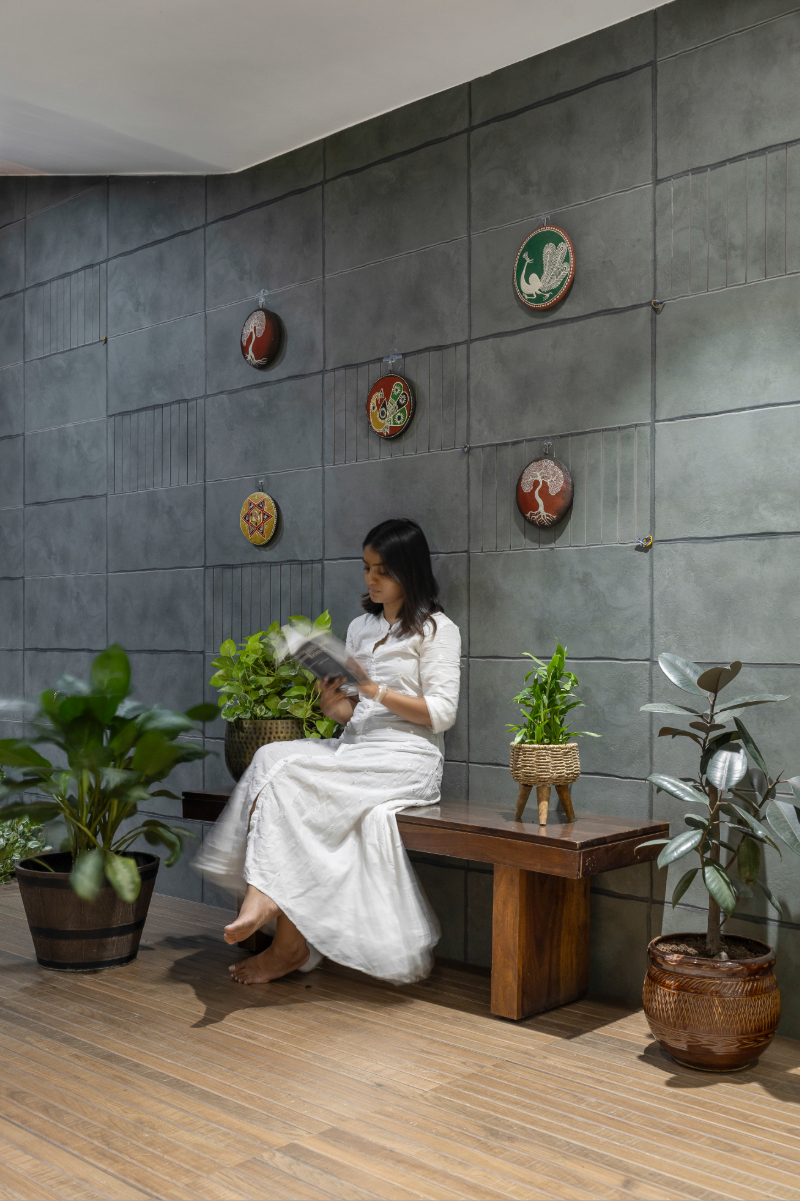
The balcony — nine floors up, the wall behind you does not feel urban. The folk art medallions are the home's most personal gesture.
Looking Back
It does not mean ornament, or pattern, or historicism. In this home, it means material honesty — a concrete floor, a brick wall, timber that shows its grain. It means objects with provenance: a handmade console, a folk-art medallion, a sunburst clock. It means a plan that makes space for the mandir and the jhula as first-order moves, not afterthoughts.
The apartment could have been sleek. It chose instead to be warm, layered, and quietly rooted. Nothing in it is borrowed from a hotel, a showroom, or another architect's project. It belongs entirely to the family who lives here — which is what every home should do, but most do not.
Credits
Principal Architect Ar. Deepak Sahajwani
Associate Interior Designer ID Vicky Gandhi
Photography Prabal
Year of Completion 2024