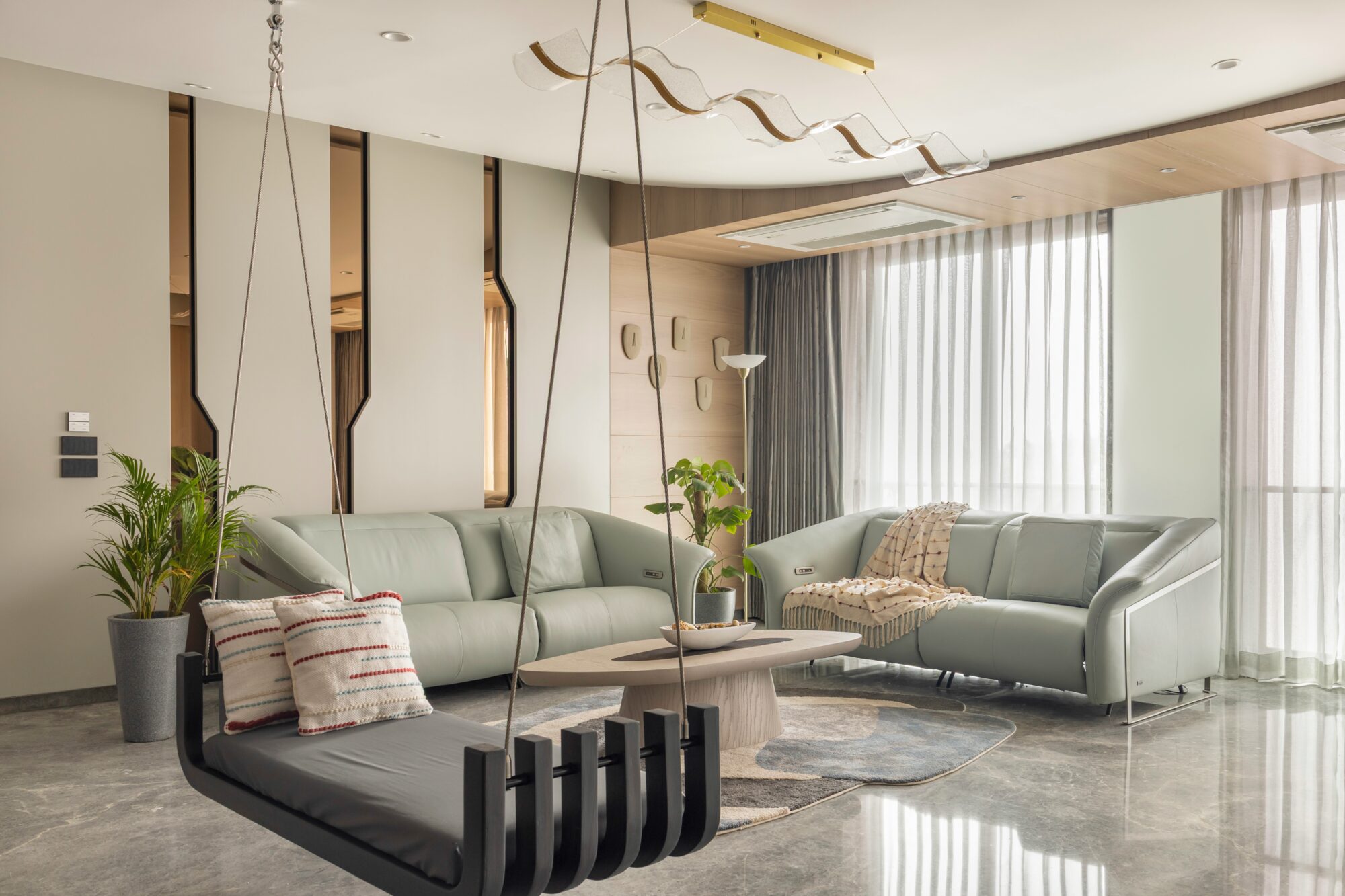
Penthouse Apartment — Tirupur, Tamil Nadu
A penthouse with the front door in the middle.
One geometry. Three floors. One home.
Penthouse Apartment — Tirupur, Tamil Nadu
One geometry. Three floors. One home.
Location
Tirupur, Tamil Nadu
Typology
Penthouse Apartment
Carpet Area
3,500 sq ft
Programme
4 BHK · Tri-level · Home theatre · Bar · Terrace garden
Automation
Full home automation
Status
Completed
The Brief
The family asked for a contemporary home: open in feel, generous in space, with every modern convenience built in. The kind of apartment where lights, climate, music, and curtains respond to a single tap.
What made the project unusual was not the brief — it was the apartment itself.
The Condition
Most apartments arrange themselves down from the entry — you walk in at the living level and go upstairs to the bedrooms. This penthouse reverses that. The entry sits on the middle of three floors. The private bedrooms are below. The terrace lounge is above.
This sounds like an inconvenience. In practice, it is the project's greatest gift. The middle floor became a clean, formal stage for the family's public life — living, dining, kitchen, pooja. Step down, and you enter the private world of the family. Step up, and you arrive in the world of celebration.
Three floors. Three moods. One front door.
The Signature
The defining gesture is a single sharp diagonal — drawn first in cove light across the living room's high-gloss feature wall, repeated above the dining soffit, mirrored again in the elder son's bedroom. It runs through the home like a melodic phrase, returning in different keys.
Around that line, the rest of the home stays restrained. Soft greige tones, fluted vertical panels, light oak, and grey marble flooring. The diagonal is allowed to be the loudest thing in the room because everything else is asked to be quiet.
Arrival — The Foyer
The entry foyer is small and deliberate. To the left, the central staircase rises and falls — backlit treads, a glass balustrade, oak-clad walls. To the right, the living room unfolds. The arrival is brief; the home declares itself in seconds.
The foyer — entry on the middle floor, with the staircase rising up to the terrace and dropping down to the bedrooms.
The Threshold
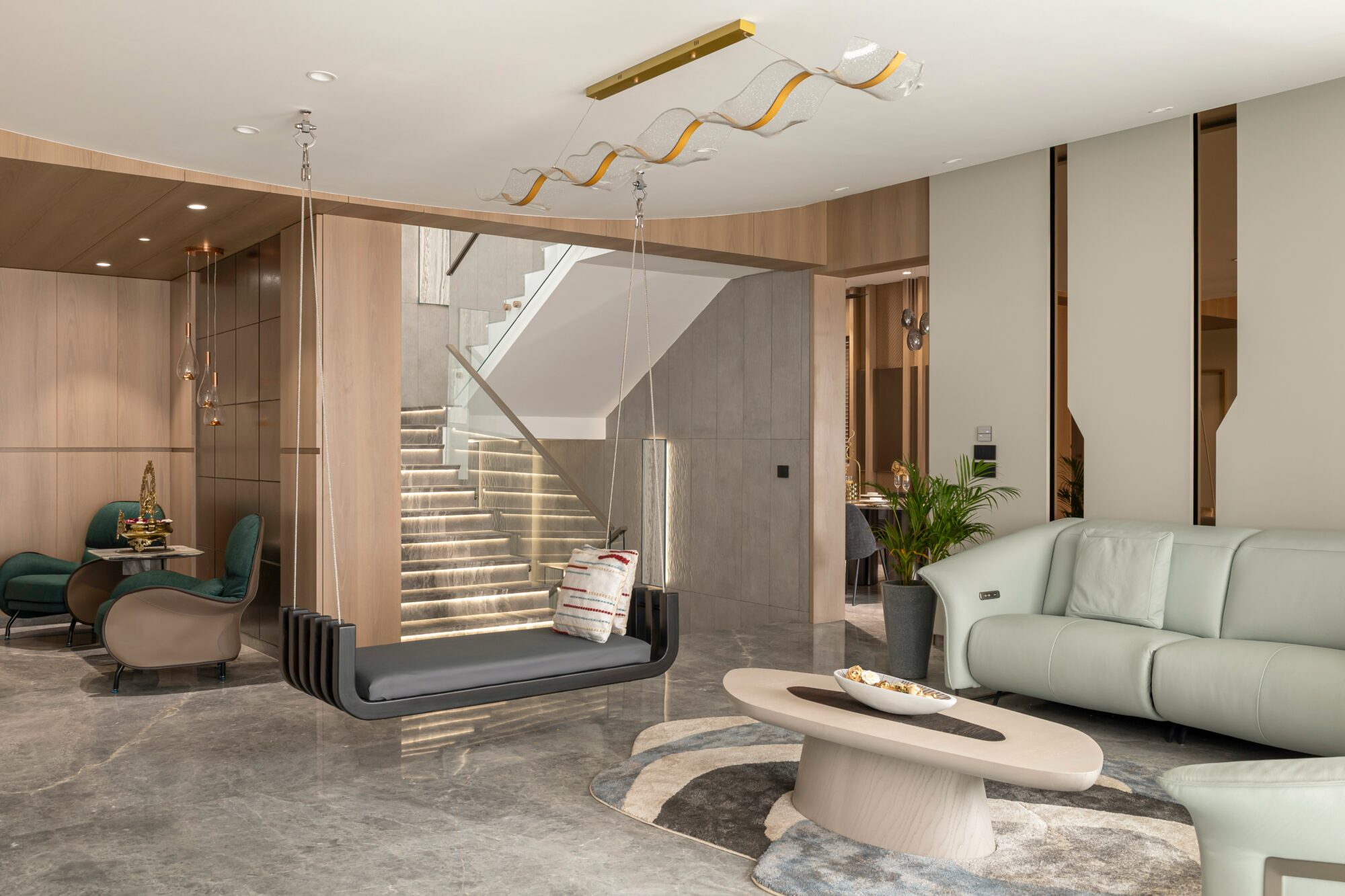
Because the entry is in the middle, the staircase does something unusual: it must work in two directions equally. Down to the bedrooms, you cross from public into private. Up to the terrace, you cross from family into festivity. The same staircase, two different journeys.
Backlit treads of grey marble float against an oak-clad wall. A swing (a jhula) hangs in the foyer beside the stair — a south Indian motif that the family insisted on, and that becomes the visual anchor of every photograph of this room.
The staircase, framed by the jhula. Up to the terrace and the home theatre. Down to the bedrooms.
The Middle Floor — Where Guests Arrive
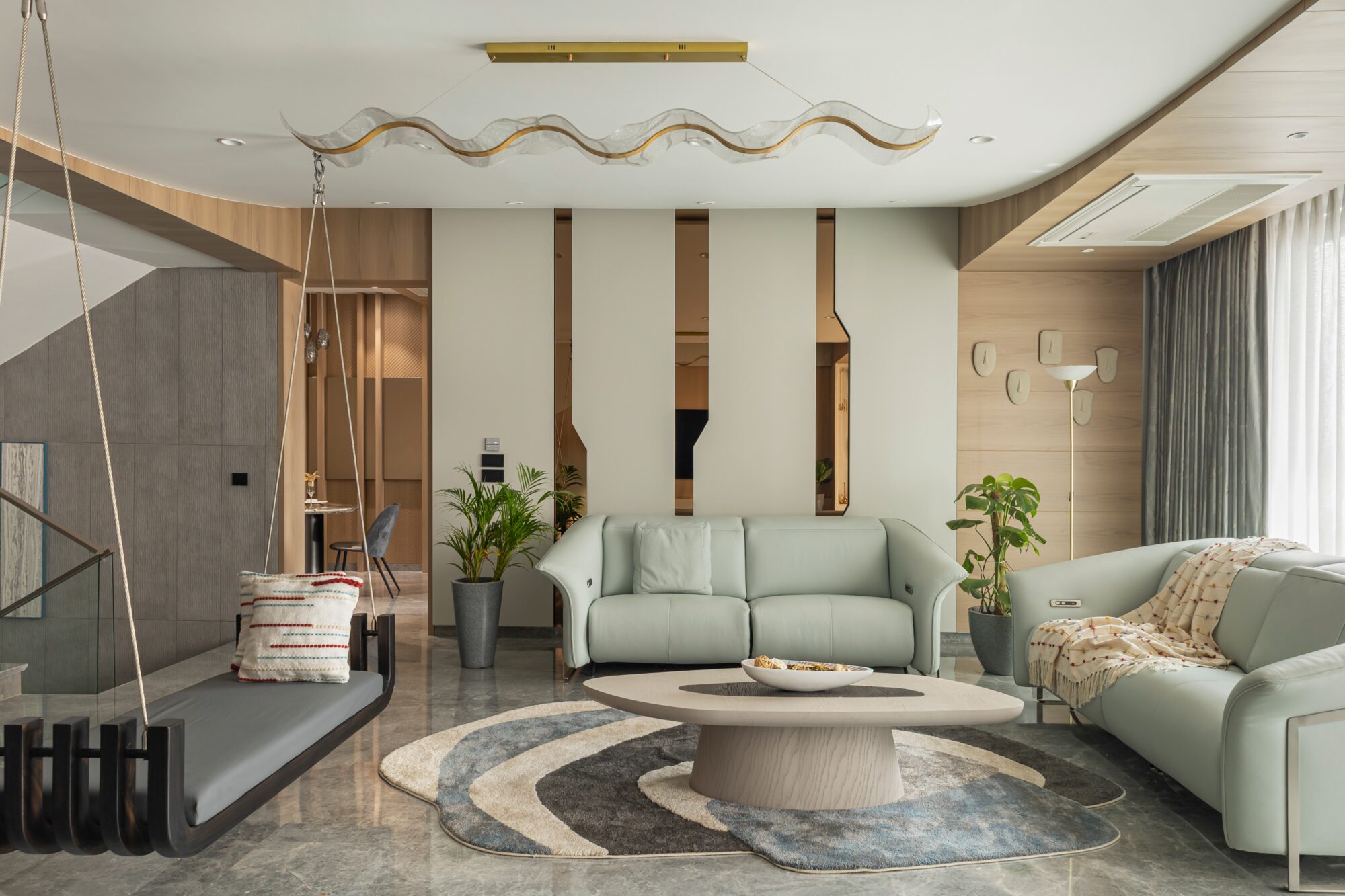
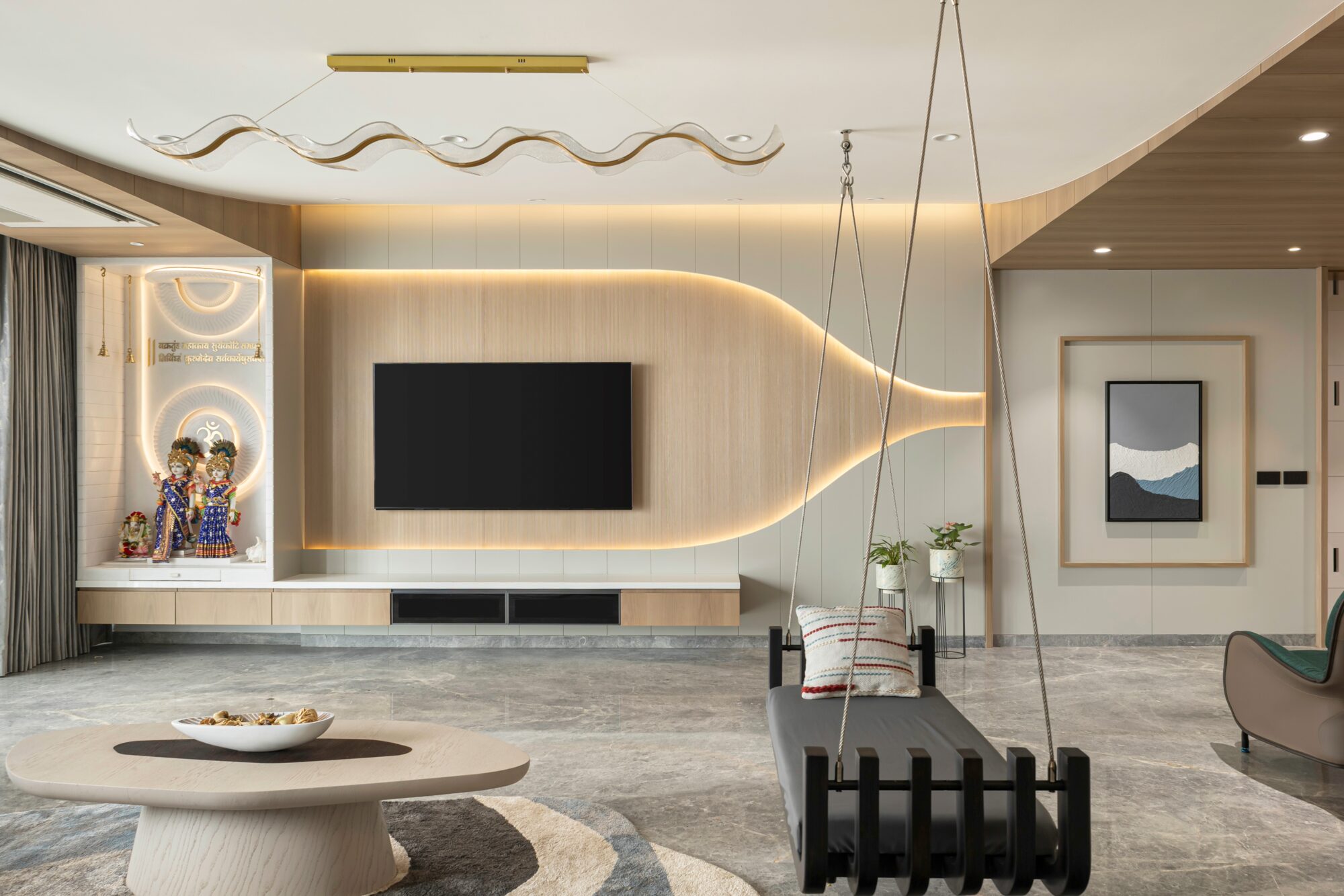
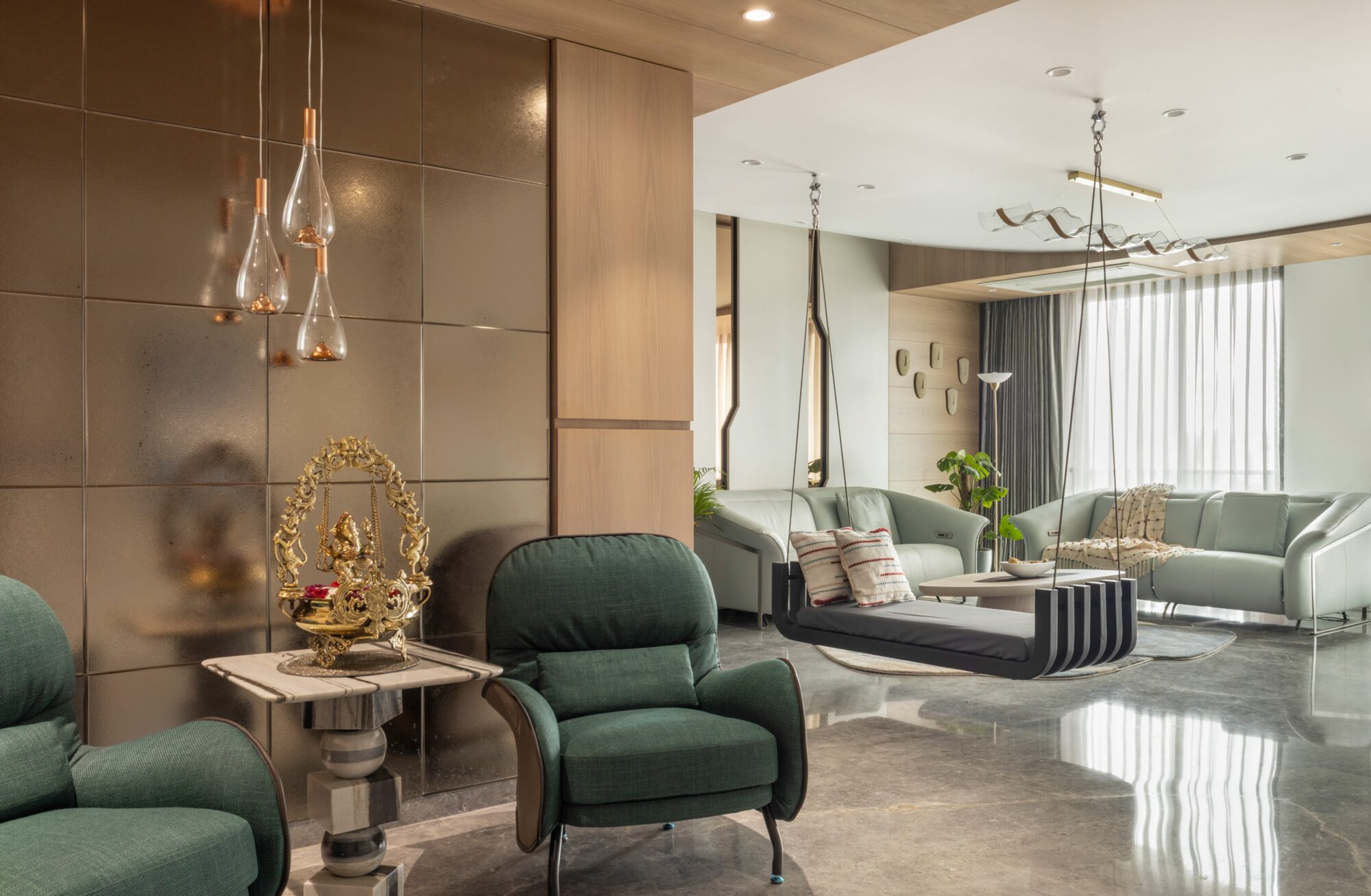
The first view, framed by the foyer jhula: the TV wall. High-gloss panels in a soft greige. A diagonal cove of light cutting across them. A custom upholstered sofa whose back panel echoes the same diagonal — design by repetition, not decoration.
The room is generous, the palette is held tight. Grey marble flooring, fluted vertical panels behind the seating, a single sculptural clock as ornament. Nothing else competes with the diagonal.
Left: a wide view of the living room — the diagonal motif visible on the TV wall, repeated in the back of the sofa. Right: the seating composition — striped statement chairs against the disciplined backdrop.
The Pooja
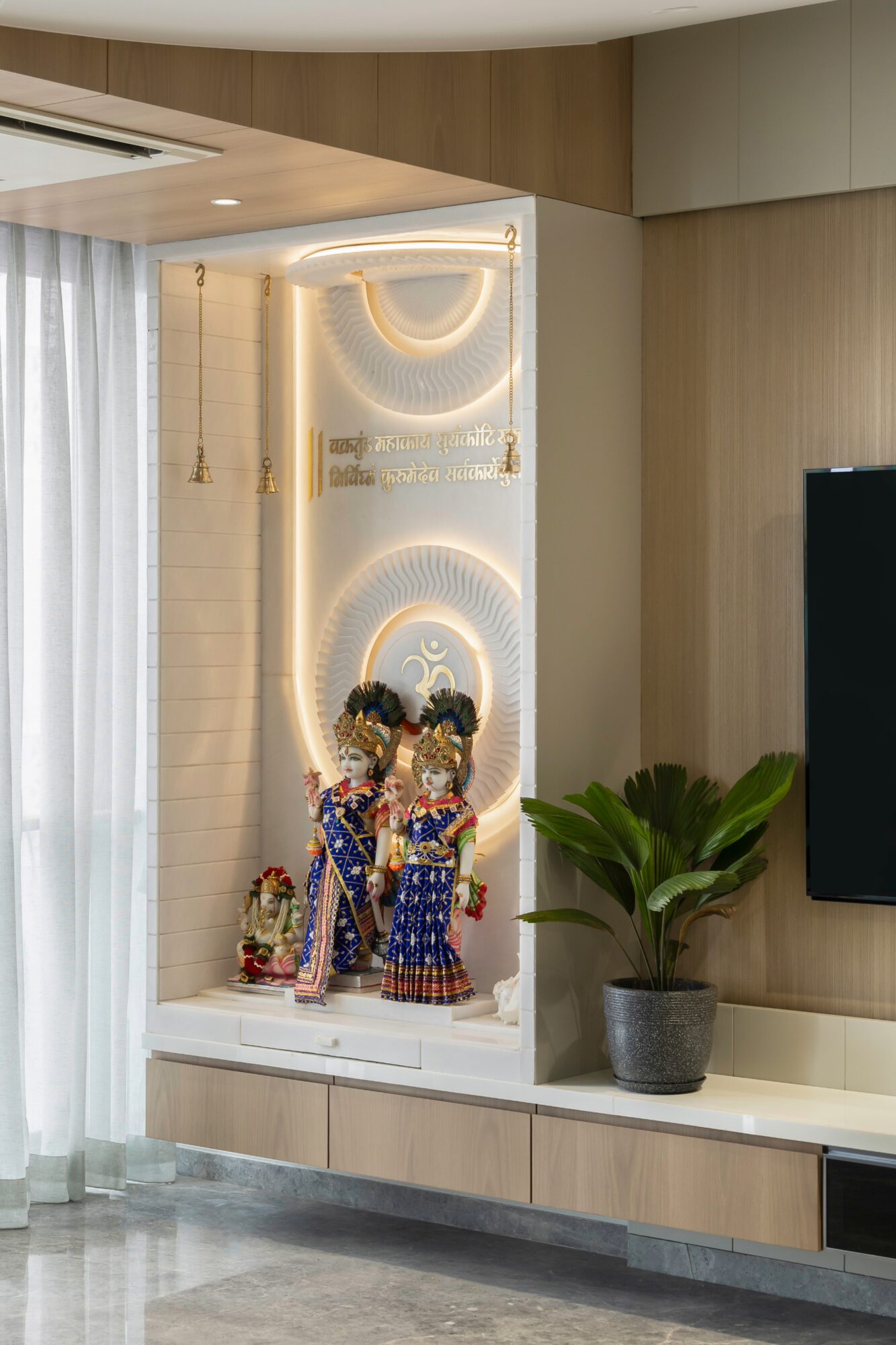
The pooja niche sits flush in the oak-panelled spine of the living room, beside the TV. Two radial fluted backdrops, a Sanskrit invocation in brass, and a quiet wash of warm light. It belongs to the public life of the family — accessible to guests, visible from the seating — and not hidden away as so many modern apartments hide it.
The pooja niche — the same geometric vocabulary as the rest of the home, applied to the sacred.
Kitchen & Dining
The kitchen is contemporary, handle-less, in a quiet mushroom-grey laminate against a book-matched marble backsplash. Practical, fully automated, and visually adjacent to the dining without being part of it.
The dining sits in the heart of the middle floor — an oval marble-topped table, velvet upholstered chairs, a mosaic feature wall behind. Above, the soffit picks up the diagonal motif again.
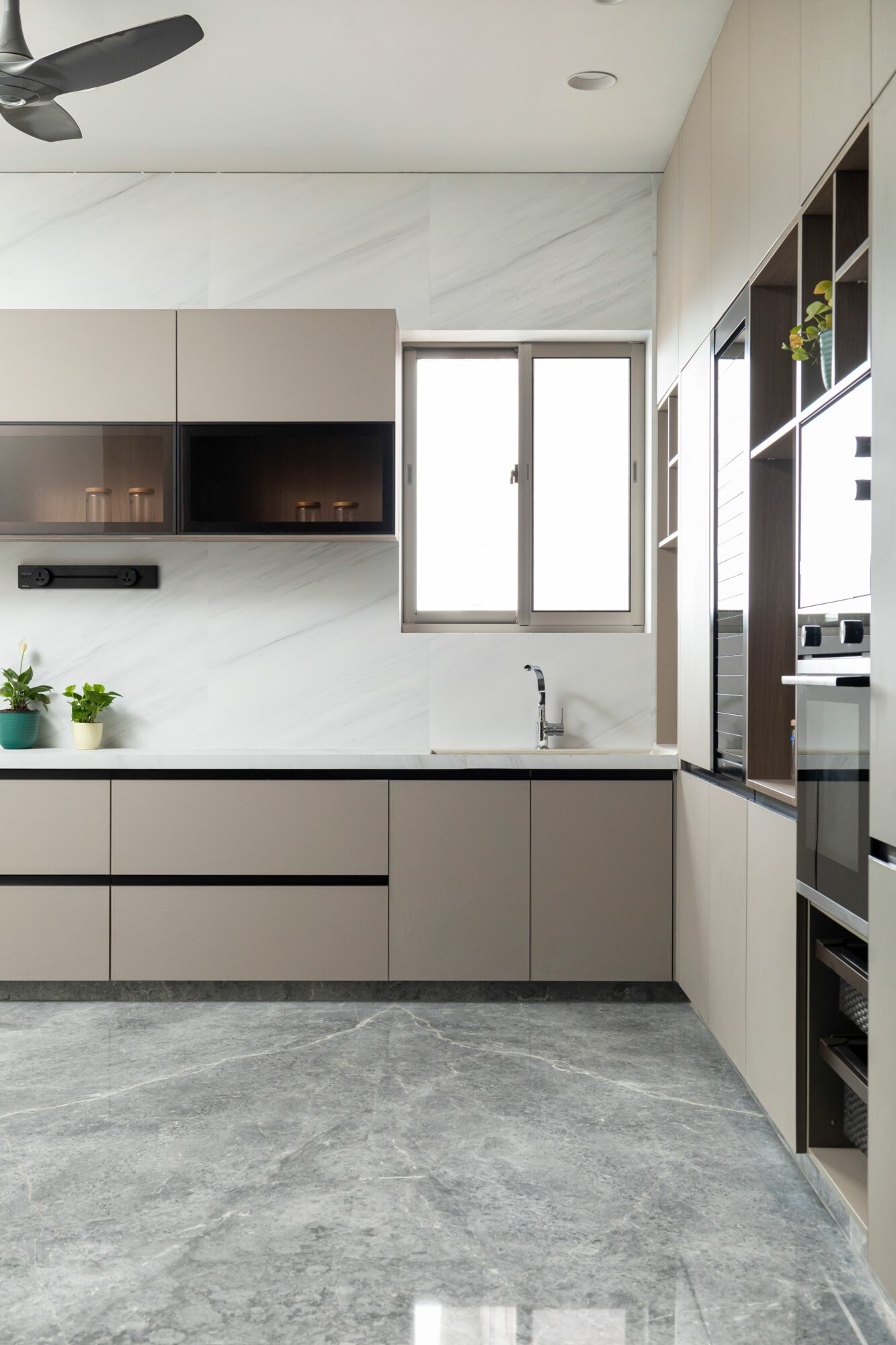
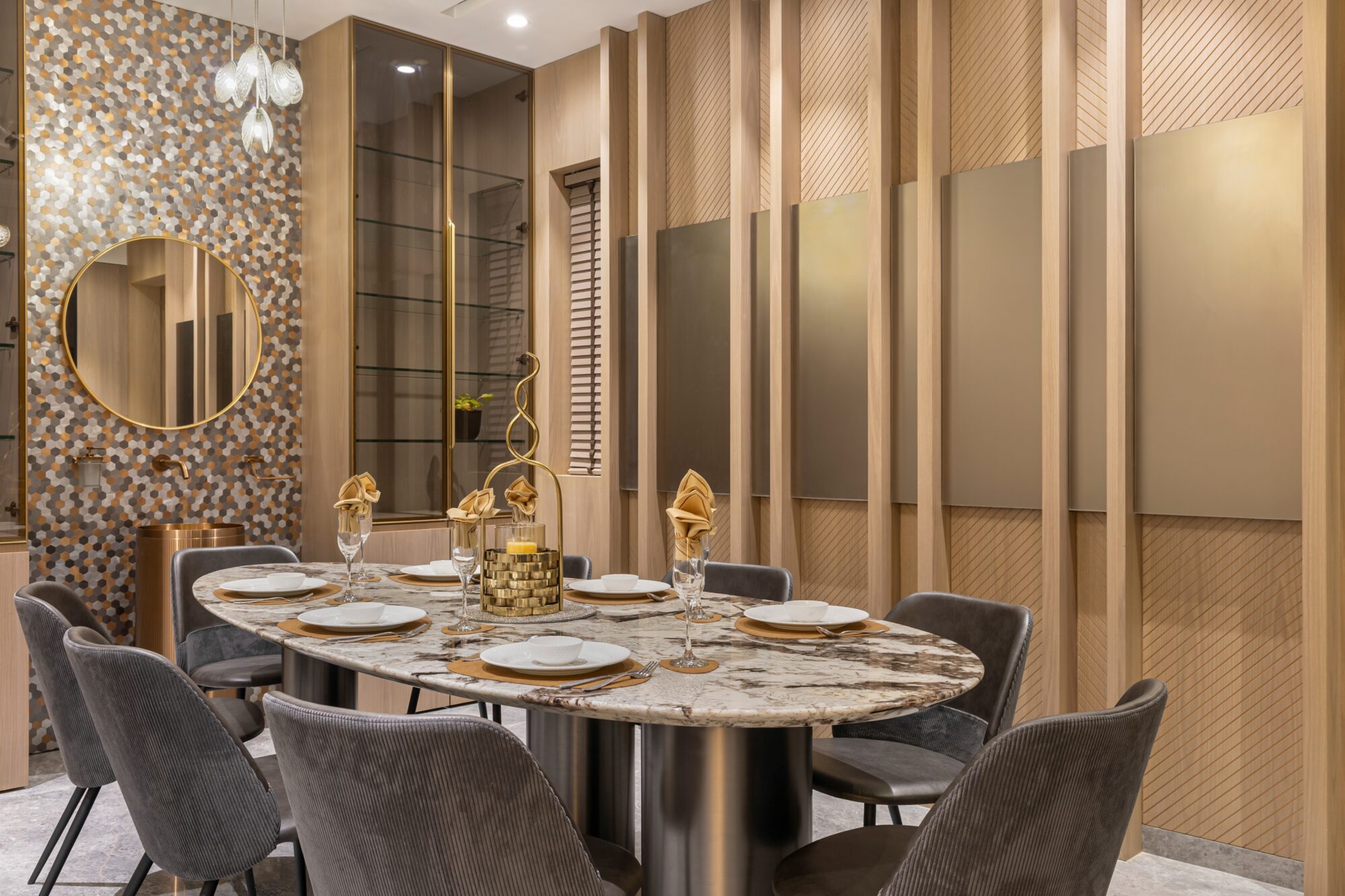
Left: the kitchen — handle-less, marble-clad, integrated with the home automation. Right: the dining — oval marble, velvet chairs, the mosaic-and-oak feature wall.
The Lower Floor — Where the Family Rests
The lower floor holds the master bedroom and bedrooms for the two sons. Rather than impose one design language on all three, each bedroom became a portrait of its inhabitant. The materials and the geometric discipline run as a common thread — the diagonal returns in the elder son's room — but the character of each space is its own.
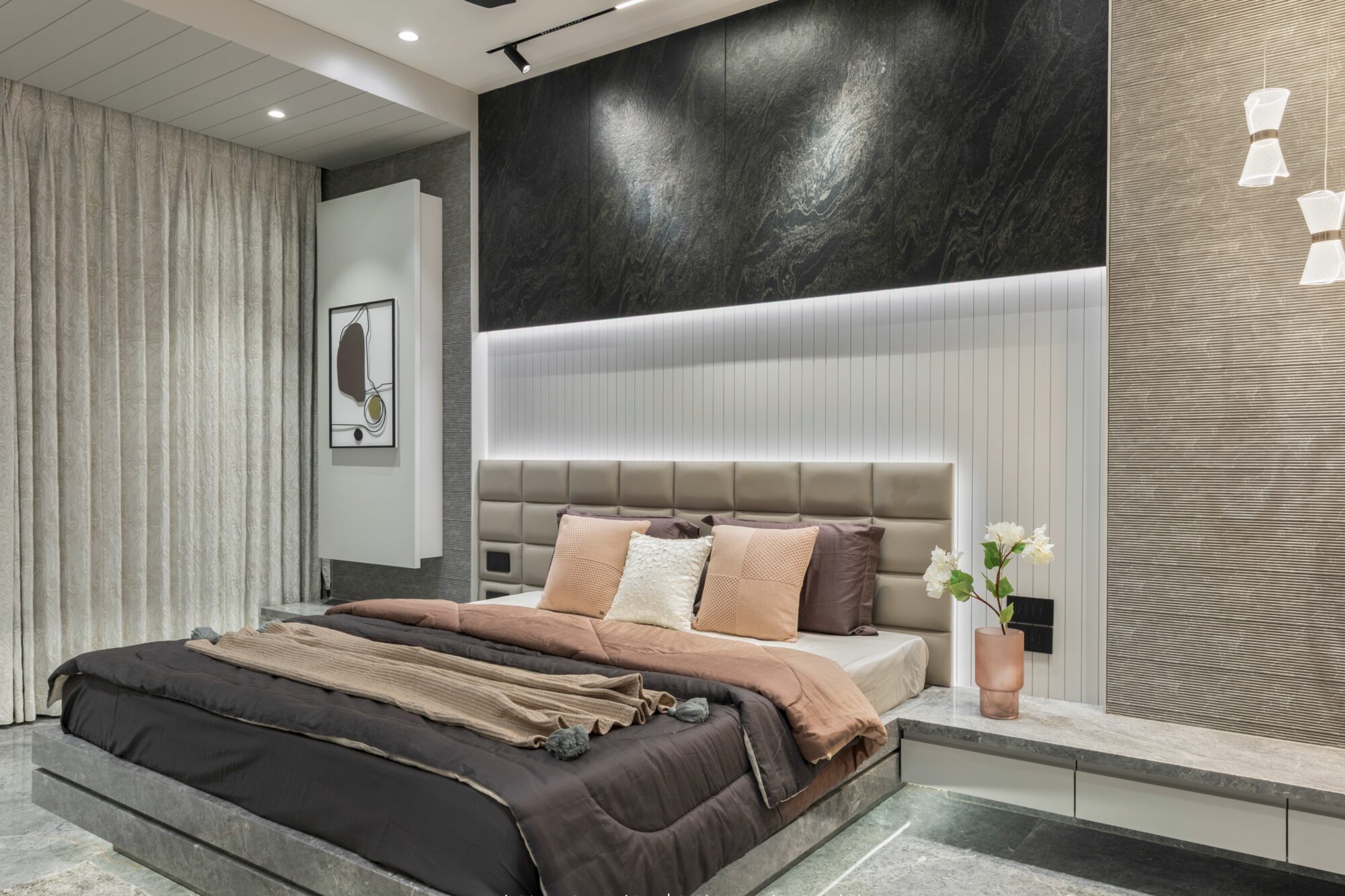
The master bedroom — calm, soft, with the family palette of light tones and a quiet diagonal cove behind the bed.
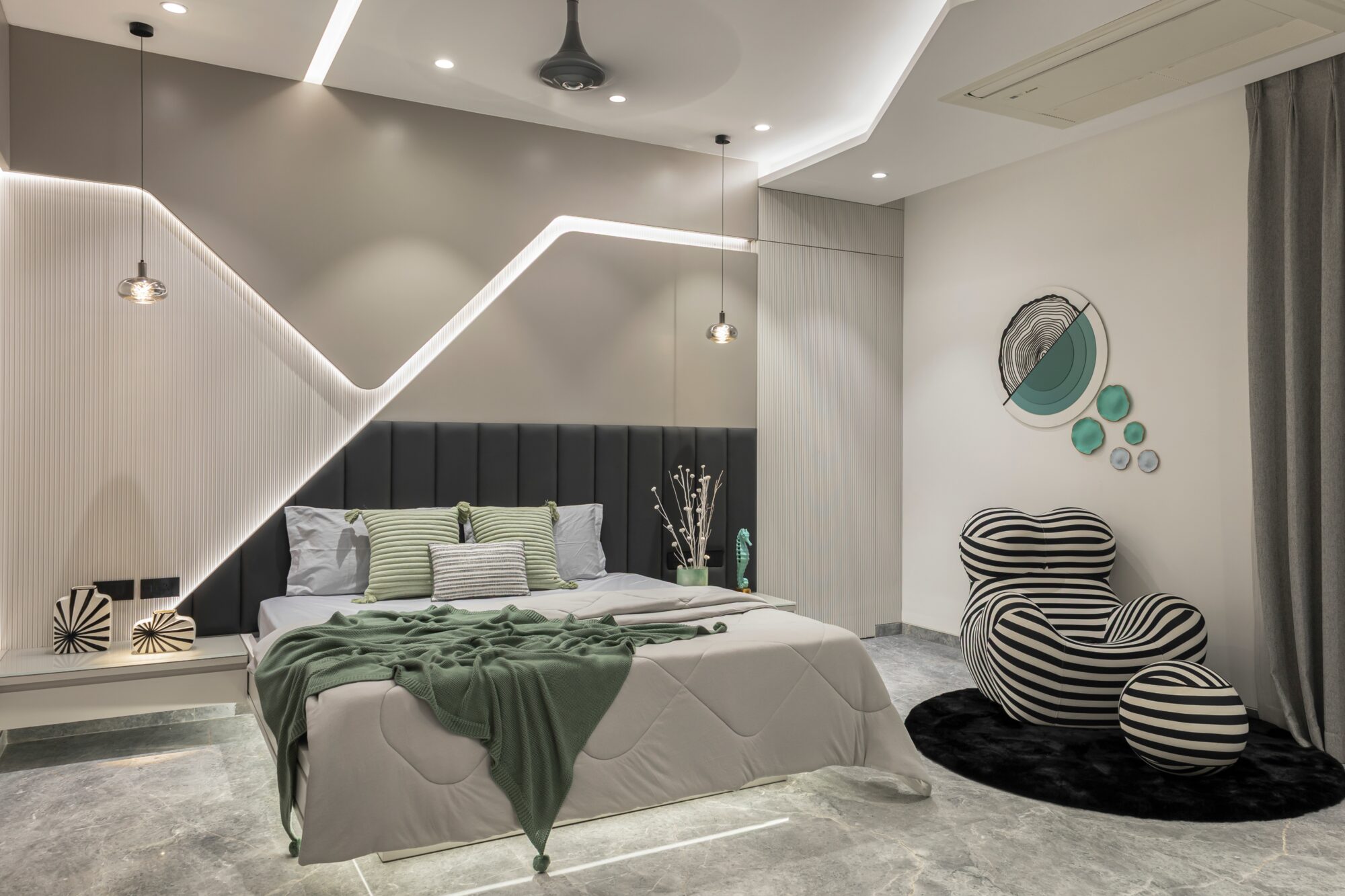
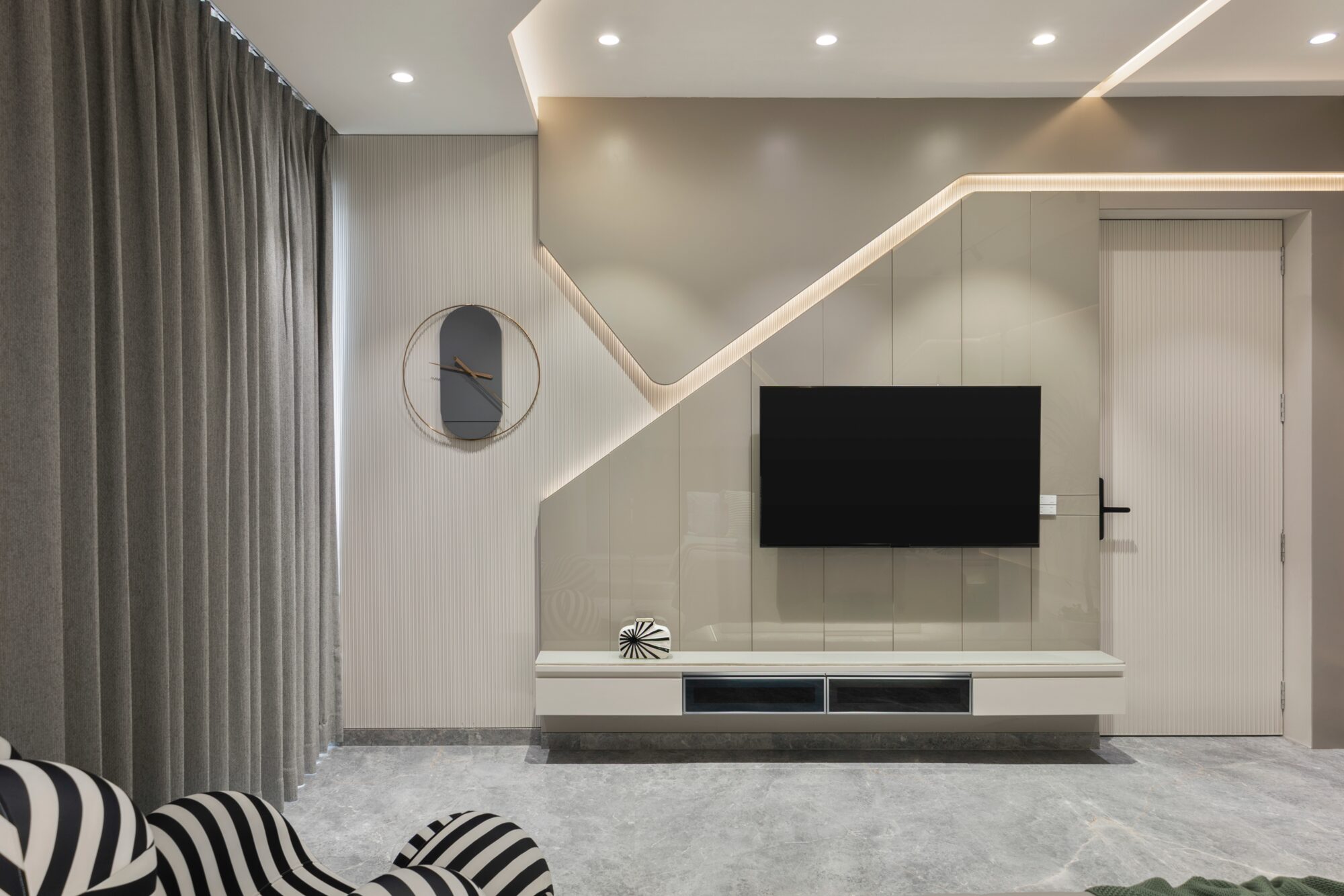
The elder son's bedroom — the diagonal motif returns, this time as a single line of light cutting across the headboard wall. The striped chair is his own.
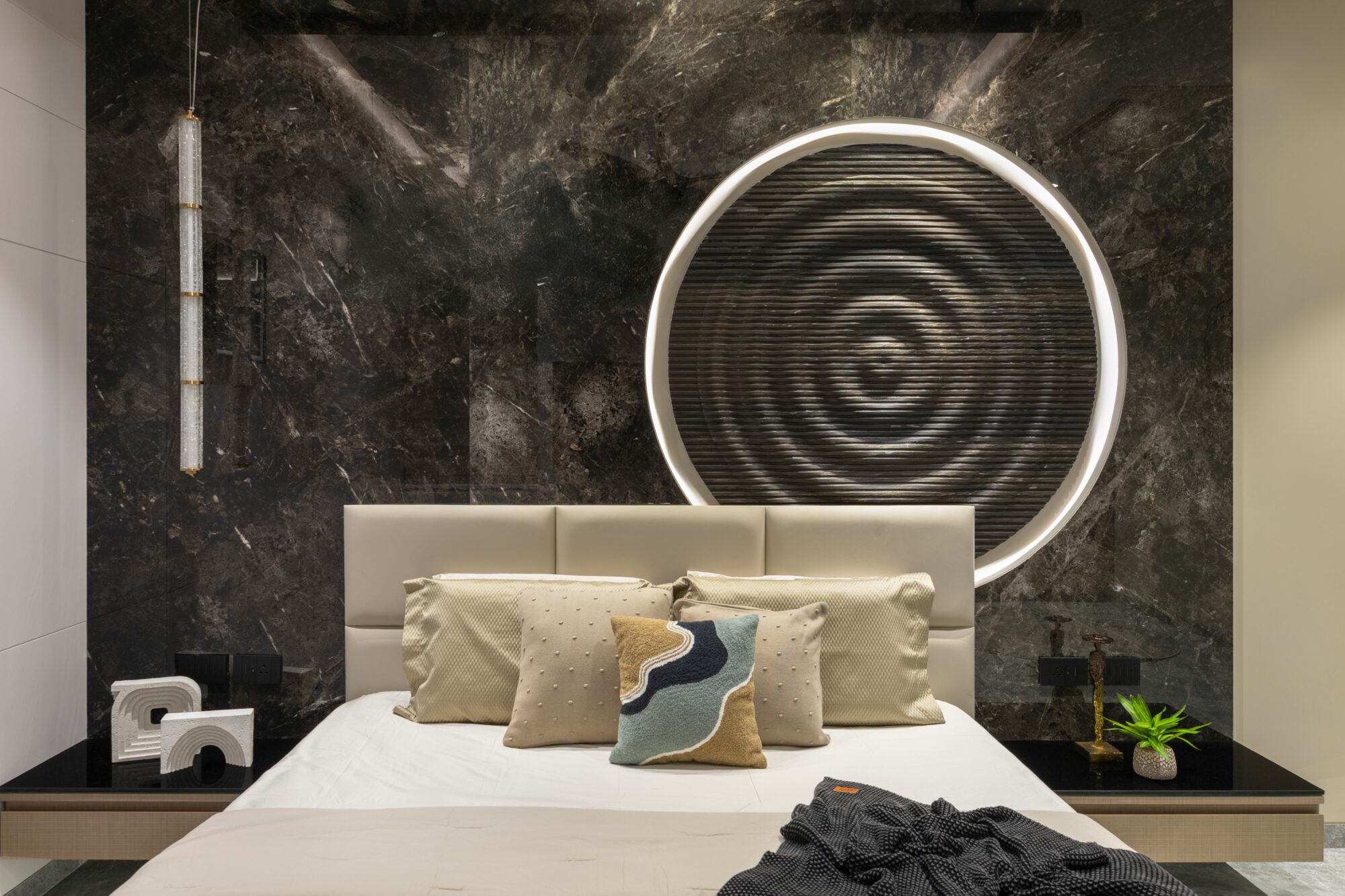
The younger son's bedroom — moodier, more graphic. A circular art panel held in a ring of light, against black stone.
The Upper Floor — Where the Family Celebrates
Up from the entry, the terrace level is the family's private entertainment world. A full home theatre — acoustically treated, with a projector screen and surround sound — opens through sliding doors onto an illuminated glass-walled bar. Step out from there, and the terrace garden unfolds: a planted lawn, a pergola lounge, a cove-lit corner bench at the parapet edge.
This is where birthdays happen, where the family watches cricket finals, where the children's friends gather. A vertical extension of the home's social life — given its own floor, away from the formal calm of the entry level.
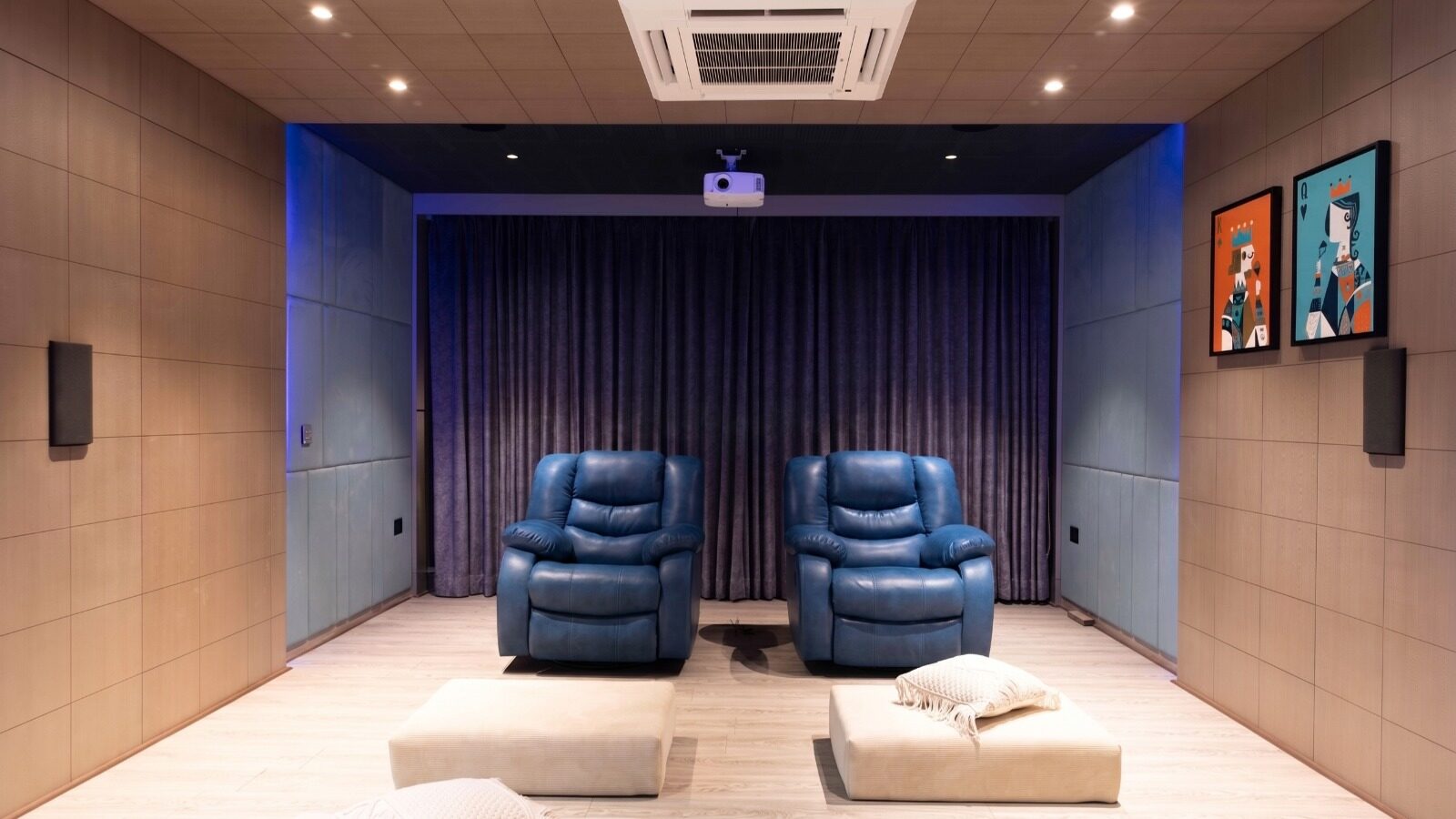
The home theatre — acoustic ceiling, twin recliners, framed art that adds character without breaking the room's quiet.
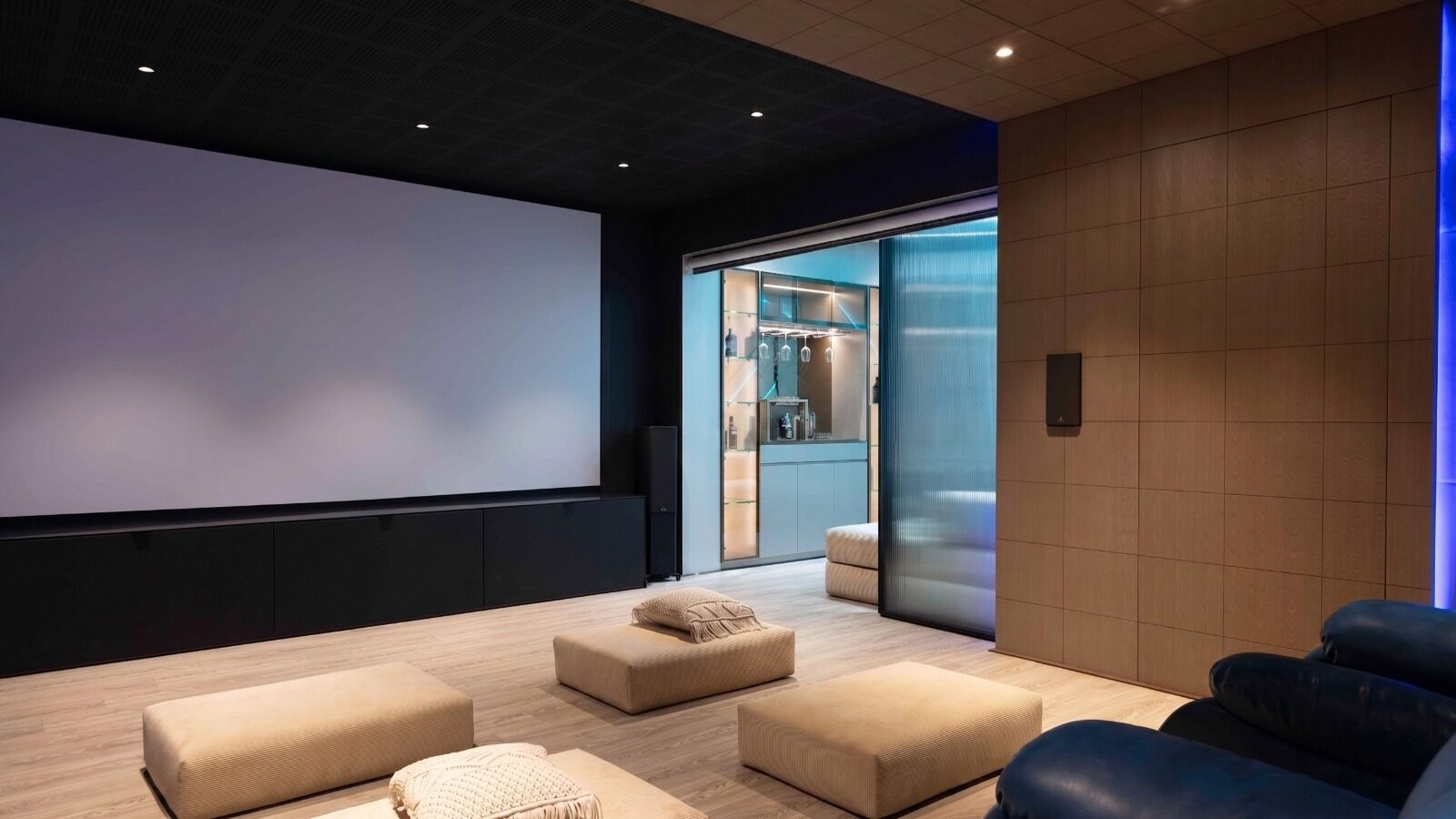
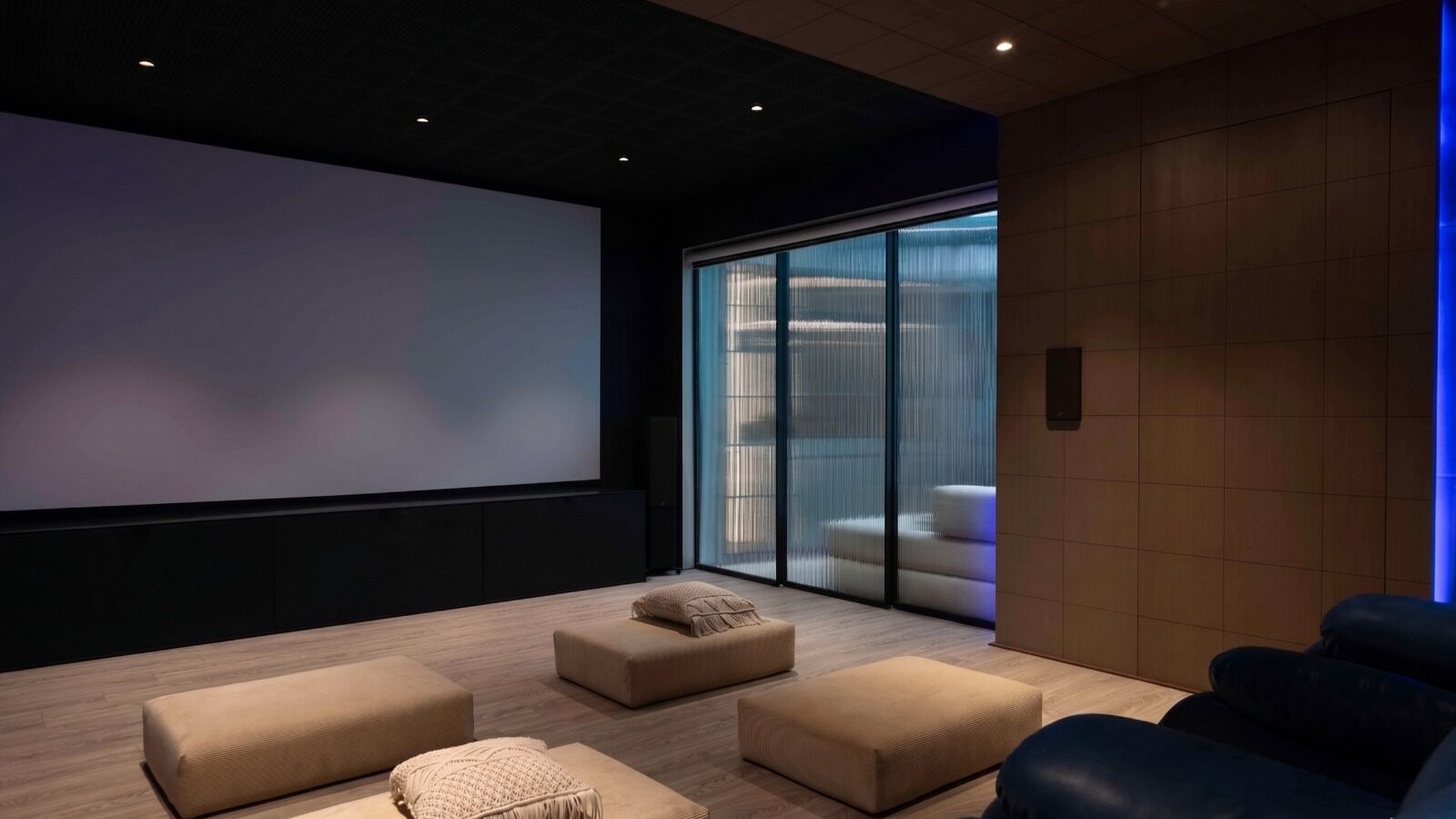
Left: the theatre opens directly onto the bar through sliding doors — film night or evening with friends, one room flows into the other. Right: the same room with doors closed and screen on, the blue cove light becoming the only ambience.
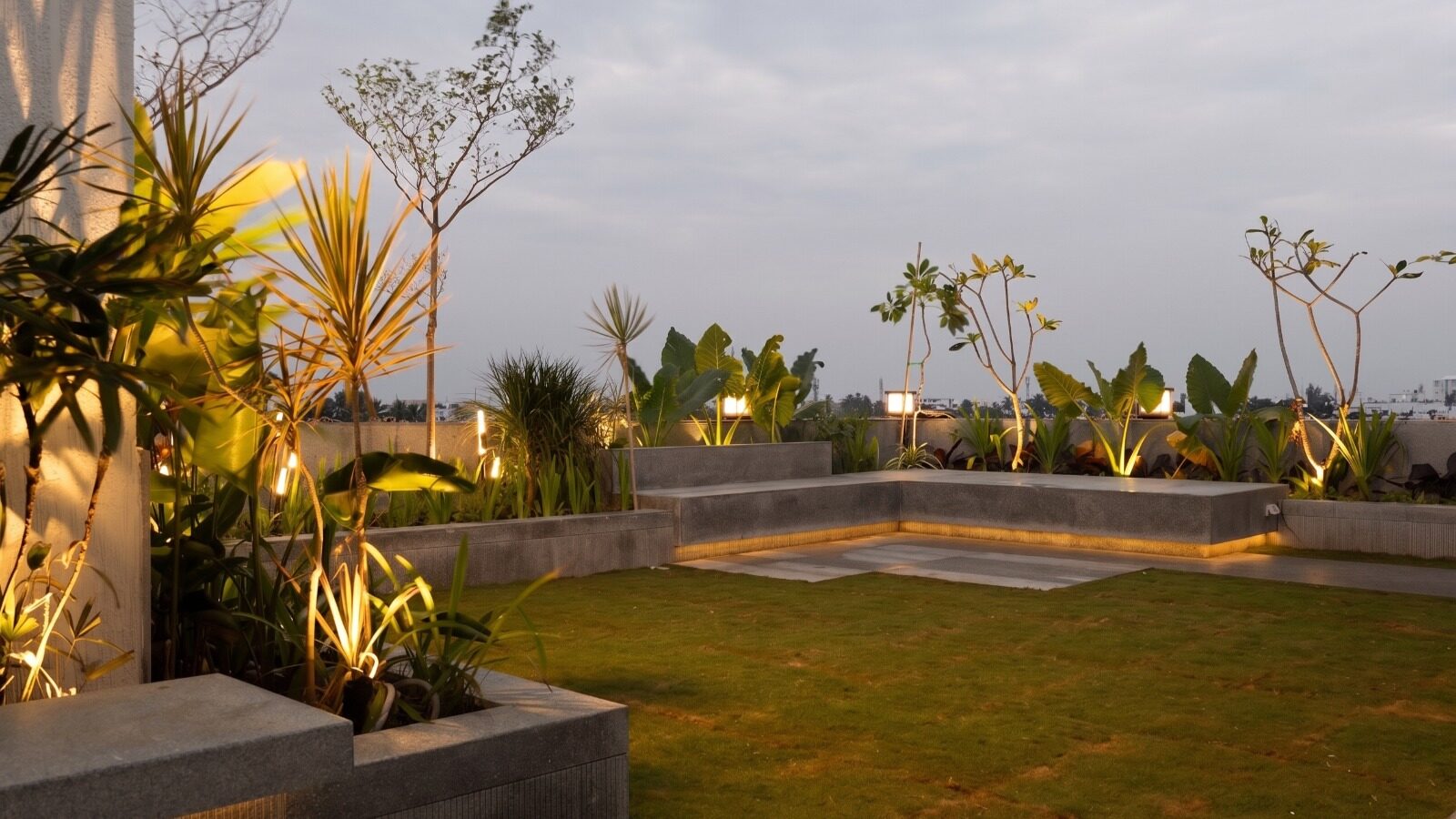
The terrace garden — a planted edge held by a long cove-lit bench. The lawn is left open; the planting and the seating do the framing.
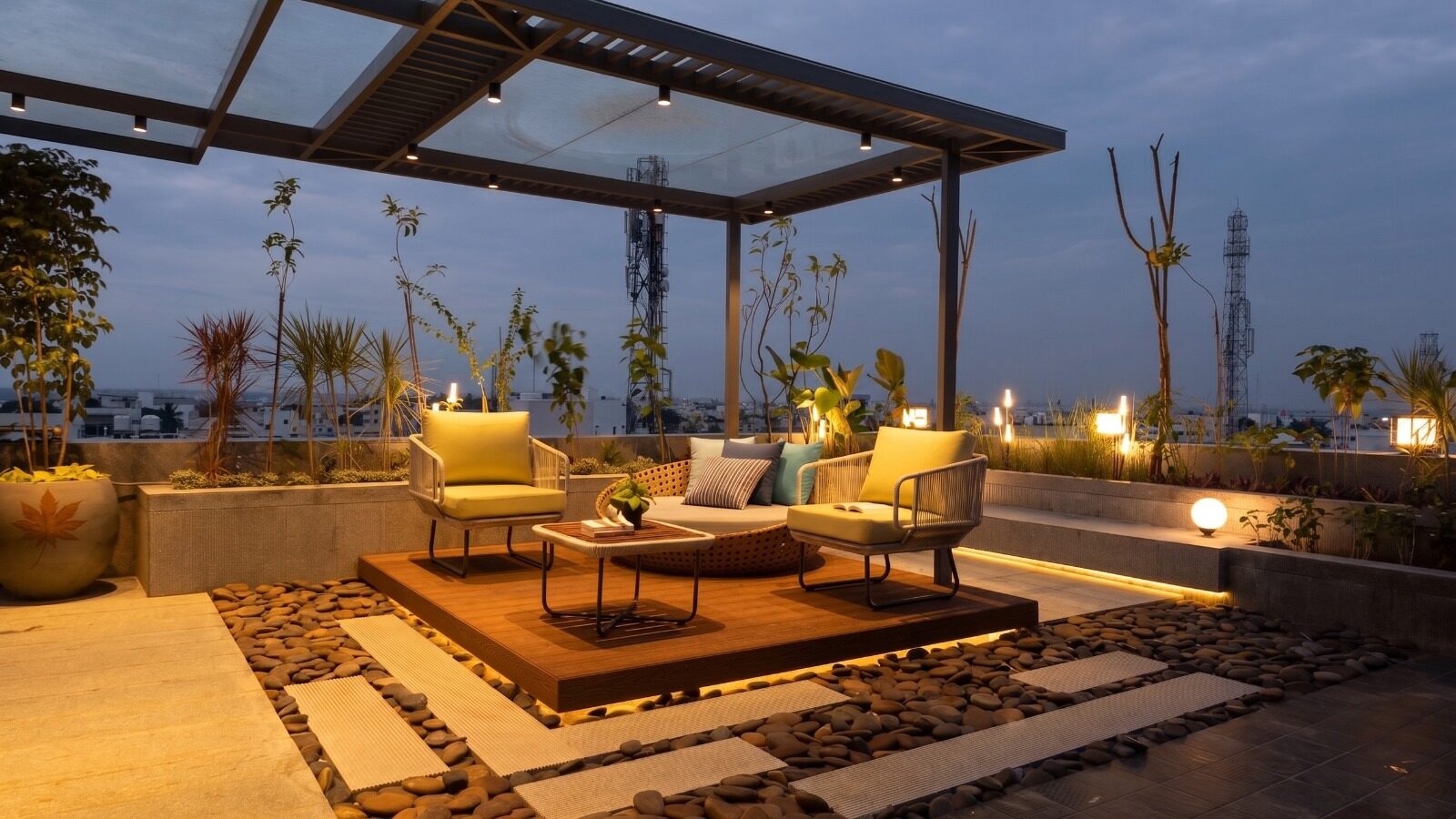
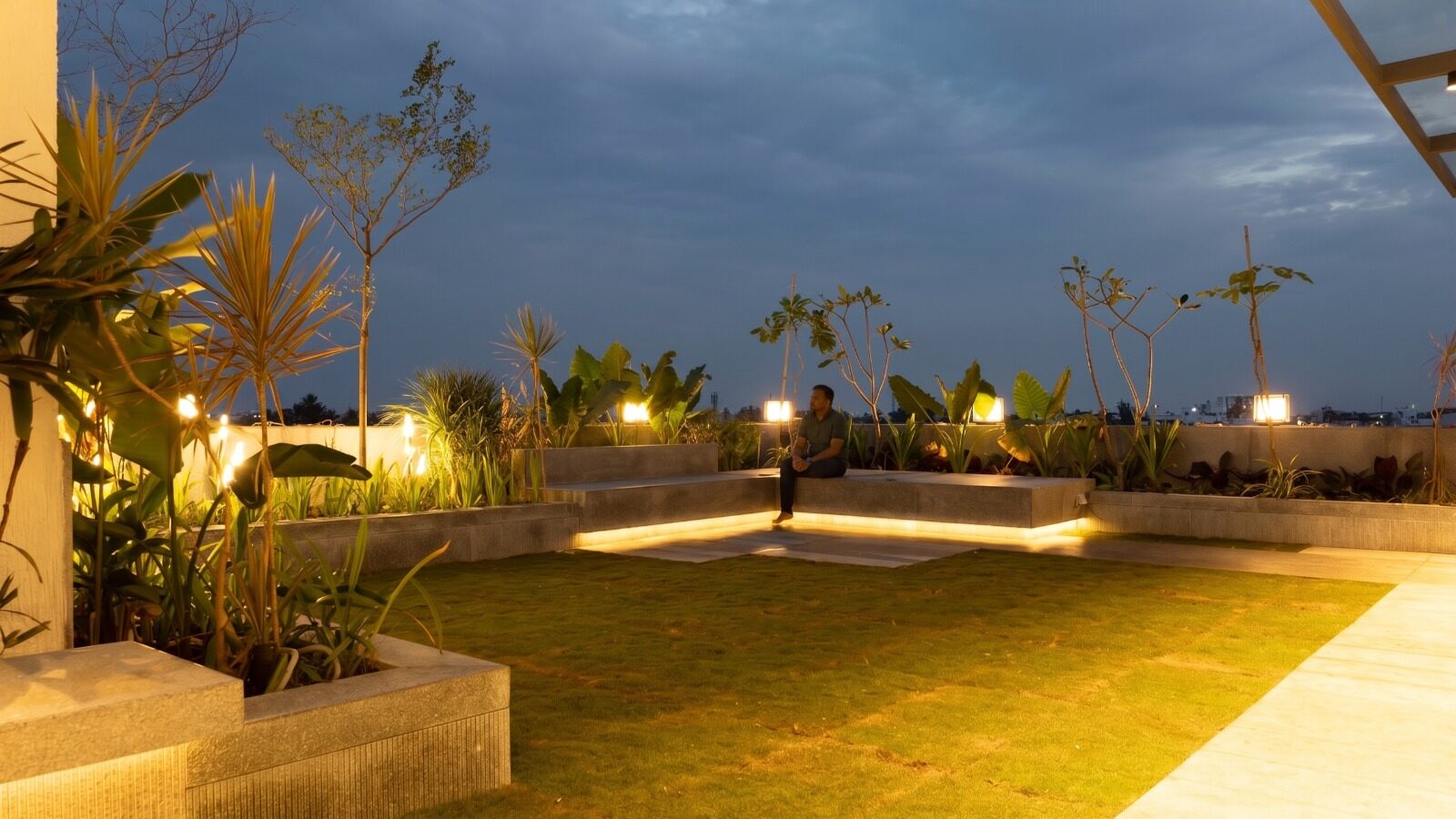
Left: the pergola lounge — the social corner of the terrace, used for evenings outdoors. Right: the same garden, lived in.
The Automation
The brief asked for a fully automated home. Lighting, climate, curtains, audio, and security all integrated into a single system the family controls from a phone or a wall panel. The challenge — as always with automation — was to make none of it visible.
No exposed control panels in living spaces. No visible speaker grilles in the theatre's main wall. The technology is real and constant, but the rooms still read as rooms, not as control consoles. That restraint is the point.
Looking Back
The middle-floor entry was a quirk of the building, not a choice. What turned it into architecture was the decision to use a single geometric idea — the diagonal — as the visual glue holding three otherwise different floors into one home.
Public on arrival, private below, celebratory above — three worlds, sharing one line. The family of four moves between them every day. The architecture, by repeating one quiet gesture, makes the whole feel like one home rather than three apartments stacked.
Credits
Principal Architect Ar. Deepak Sahajwani
Interior Designer ID Vicky Gandhi
AC Consultant Sai Air Comfort Pvt Ltd
Electrical Contractor A H R Electric House
Plumbing Contractor Pankaj
Furniture Contractor Dalchand Suthar
Civil & Marble Contractor Malchand
False Ceiling Contractor Gani
Landscape Consultant Daksh Patel
Photography Prabal
Year of Completion 2025